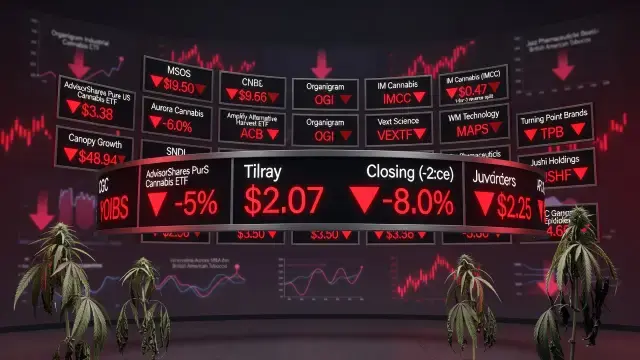
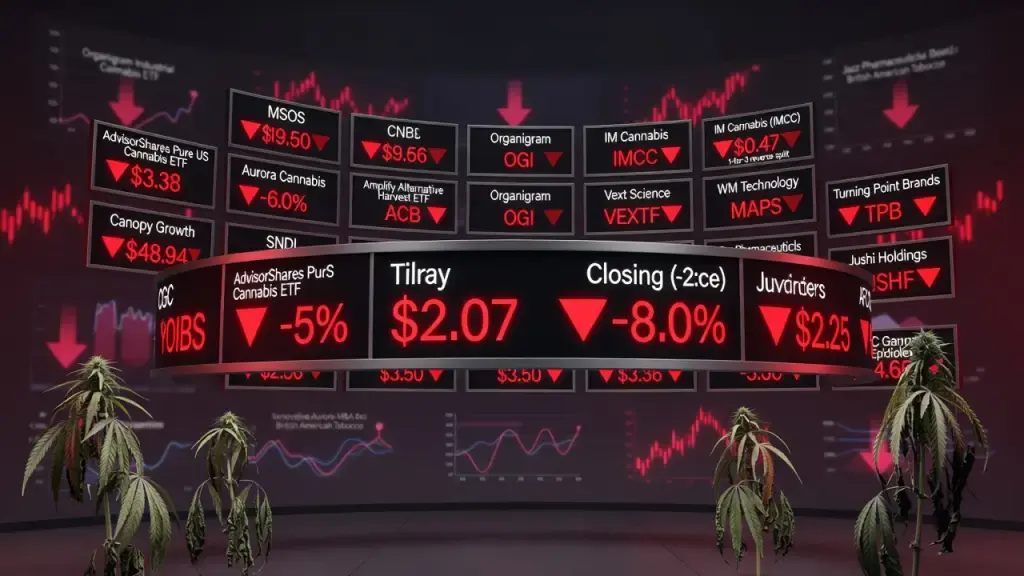
Tilray Brands closed Friday, November 20, at $2.07, down 8.0% from its previous close of $2.25, a level below what Invezz flagged as a record low for the stock just three days earlier. The slide wasn't isolated. All four sector ETFs tracked by Business of Cannabis fell between 5.6% and 6.0%, and only four of the 35 tickers on the board finished above water. This is a sector-wide pullback, not a company-specific event, and that distinction matters for anyone trying to read the tea leaves.
A Down Day With No Single Culprit
Here's the catch for anyone searching for a headline to explain the move: there isn't one. No company filing, no regulatory announcement, no earnings surprise tied to Tilray's decline turned up in our review. The AdvisorShares Pure US Cannabis ETF (MSOS) dropped 5.6% to $3.38, the Amplify Seymour Cannabis ETF (CNBS) fell 6.0% to $19.50, and both the Amplify Alternative Harvest ETF (MJ) and AdvisorShares Pure Cannabis ETF (YOLO) lost more than 5%. When the broad baskets move in lockstep with individual names, that's usually a signal of macro pressure, thin liquidity, or sentiment washing through the sector rather than any one operator stumbling. For investors, the lesson is to separate noise from fundamentals before reacting to a single ticker's chart.
Breadth told the same story. Vext Science (VEXTF) and WM Technology (MAPS) posted modest gains, and Turning Point Brands (TPB) and Jushi Holdings (JUSHF) barely held positive territory. Everything else, including Canopy Growth (CGC), SNDL, Aurora Cannabis (ACB), and Organigram (OGI), traded lower alongside the broader cannabis complex.
IM Cannabis Heads Into a Reverse Split
IM Cannabis (IMCC) fell 13.0% to $0.47 ahead of a 1-for-3 reverse stock split taking effect November 23, according to Investing.com. On paper, the mechanical consolidation would put the post-split quote near $1.40, comfortably above Nasdaq's $1.00 minimum bid requirement that triggered the action in the first place. That sounds tidy on paper, but the arithmetic only sets a starting reference point. The market, not the consolidation math, determines where the stock actually opens once shares trade on a consolidated basis Monday. Reverse splits don't change underlying enterprise value; they change share count and optics, which matters for exchange compliance but says nothing about operating performance.
M&A Overhang Still Weighing on Canadian Names
Aurora Cannabis and Organigram both traded lower, continuing a pattern visible since Tobacco Reporter's November 3 report that Organigram agreed to acquire Aurora, with British American Tobacco backing the deal through a private placement into Organigram. Neither company has issued fresh disclosure since, so the current share levels likely reflect the same broad sector weakness rather than new deal-specific concern. Pending consolidation in the Canadian licensed producer space remains a live variable for anyone tracking supply-side capacity and wholesale pricing north of the border.
What This Means for Operators and Allocators
For dispensary operators and multi-state operators, public equity swings like this rarely translate directly into store-level economics; retail margins, 280E tax exposure, and state-level wholesale pricing move on their own timelines. But capital markets sentiment still shapes financing costs, and a battered sector tape makes it harder for growth-stage operators to raise equity or refinance debt on favorable terms. Innovative Industrial Properties, the cannabis-focused real estate investment trust, fell 3.3% to $48.94, and AFC Gamma, a cannabis lender, dropped below $3.50. Both are useful proxies for how credit markets are pricing sector risk. Jazz Pharmaceuticals, which markets the cannabidiol medicine Epidiolex, also fell, down 4.6% to $236.45, a reminder that even pharmaceutical-grade cannabinoid products aren't insulated from sector-wide equity pressure, even when the underlying regulatory and clinical story hasn't changed.