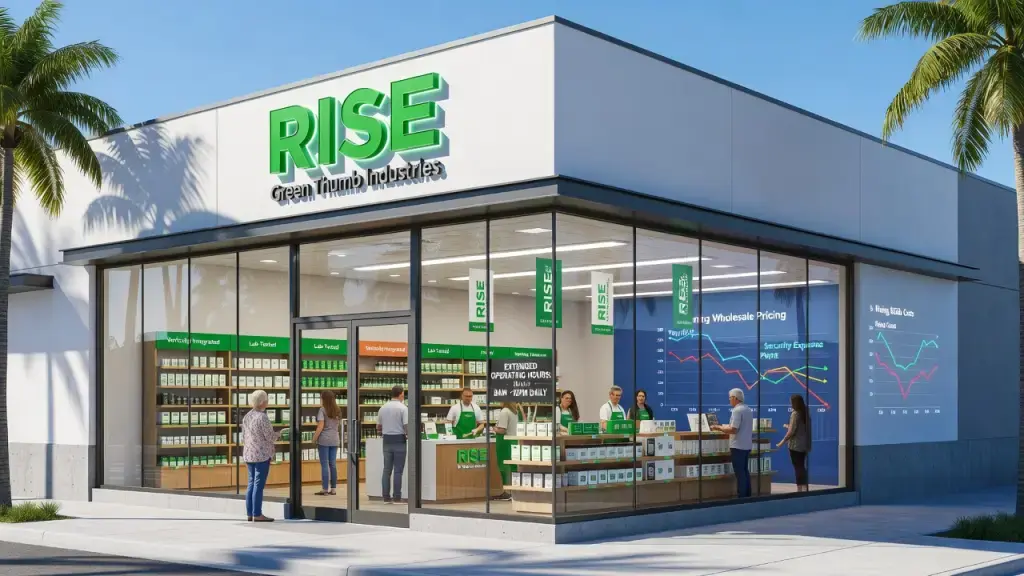
Green Thumb Industries has opened RISE Dispensary Cape Coral, its 25th retail location in Florida and more than 120th store across its national footprint. The store will serve registered medical patients in Lee County under Florida's medical cannabis program, with extended weekly hours aimed at improving access. On paper, it's another line item in a steadily growing retail network. In practice, the opening lands at a moment when the economics behind that growth deserve more scrutiny than the store count alone suggests.
Another Store, Same Underlying Math
Florida's medical market runs on vertical integration - operators grow, process, and sell under a single license structure, which keeps supply chain control in-house but also means every new dispensary adds fixed costs before it adds meaningful revenue. Build-out, staffing, POS infrastructure, compliance logging, and inventory tied to seed-to-sale tracking all come due well before a store's sales ramp stabilizes. A 25th location isn't a free addition to the ledger; it's a bet that patient demand in Lee County justifies the overhead, in a state where wholesale pricing on flower and branded products has been trending softer across the board.
That's the tension sitting underneath this expansion. Green Thumb's model leans on branded consumer products moving through its own retail doors, which in theory supports margin better than relying on third-party wholesale accounts. But if same-store sales growth is flat to slightly negative - which is the picture management has signaled for the near term - then opening additional stores mostly shifts volume around rather than creating new demand. More SKUs on more shelves does not automatically mean more profit per square foot.
What Rising SG&A Means for the Growth Story
Selling, general, and administrative costs climb almost mechanically with each new storefront - payroll, security, local compliance filings, point-of-sale maintenance, and the 280E tax burden that still applies to plant-touching cannabis businesses regardless of state legality. That last piece matters more than people outside the industry tend to realize: federal tax code denies ordinary business deductions to cannabis companies, which compresses net margins even when gross retail performance looks healthy. Any movement on Schedule III rescheduling would ease that specific pressure, but it hasn't happened yet, and operators are not supposed to plan around it as though it had.
For a multi-state operator the size of Green Thumb, the Cape Coral opening is a rounding error in isolation. The real question for anyone evaluating the company is whether its Florida stores - now numbering 25 - can scale fast enough in throughput and operating efficiency to offset the cost creep elsewhere in the business. Analysts split sharply here: some see Schedule III tax relief as the lever that rebuilds earnings toward the triple digits by the end of the decade, while others model continued cost pressure dragging earnings down toward roughly half that level. Both views can't be right, and the gap between them is wide enough to matter for anyone pricing the stock.
Compliance and Access Still the Baseline
None of the financial debate changes the operational basics patients and regulators actually care about. Florida's medical program requires registered patient ID verification at point of sale, compliant packaging with required labeling, and batch-level lab testing with certificates of analysis available for the products on shelf. Extended store hours improve access for patients managing chronic conditions, but they also add staffing and compliance-monitoring hours that show up in the same SG&A line investors are watching. Growth and discipline aren't opposites here - they're the same ledger, viewed from different ends.