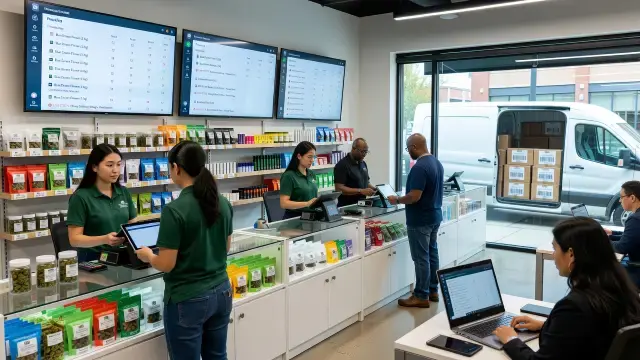
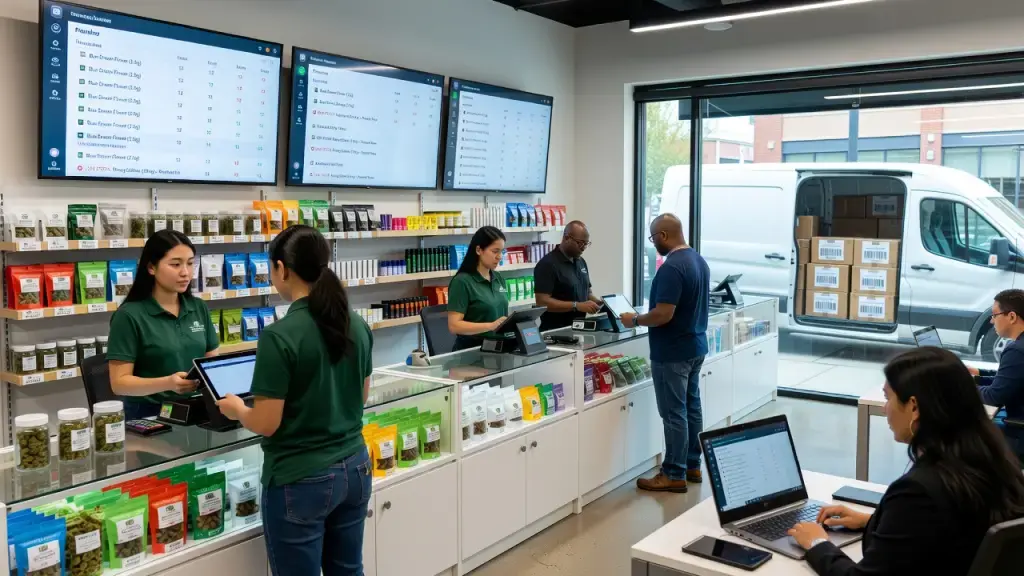
A mismatched stock count sounds like a back-office nuisance. In a licensed cannabis dispensary, it's a compliance exposure, a customer complaint, and a staffing drain rolled into one. Real-time inventory systems - which update counts the instant a sale, transfer, return, or adjustment happens, whether it originates at the POS terminal, the online menu, or a delivery vehicle - have moved from a nice-to-have to an operational baseline for operators trying to keep state regulators satisfied and shelves honest.
Why Manual Counts Stopped Working
Dispensaries used to run end-of-day reconciliations: count the budroom, compare against the register tape, chase down the difference. That worked when sales flowed through a single channel. It doesn't hold up now. U.S. Census Bureau data shows e-commerce accounted for 16.1 percent of total U.S. retail sales in 2024, and cannabis retail has followed the broader shift toward multichannel buying - in-store, online ordering, delivery. When three channels draw from one static count that only updates overnight, discrepancies aren't an edge case. They're the default state of the business.
The mechanism is straightforward enough: POS, online store, delivery dispatch, and back office all connect to a single shared inventory record. Every completed transaction - a counter sale, a web order, a delivery drop - deducts stock immediately from that one record, rather than from a channel-specific silo that gets reconciled later. Budtenders stop selling items that left the shelf an hour earlier. Online menus stop advertising products that sold out at noon.
The Compliance Layer Nobody Can Skip
Here's the part that separates cannabis inventory from standard retail stock management: state seed-to-sale tracking. Markets that use METRC - Michigan and Massachusetts among them - require licensees to log cultivation, manufacturing, transport, testing, and sale activity through the state system using serialized tags and package labels. The Massachusetts Cannabis Control Commission mandates Metrc use across the full supply chain. Michigan's Cannabis Regulatory Agency took over paying licensees' monthly statewide Metrc monitoring fees starting October 1, 2024, underscoring how central that system is to staying licensed in the first place.
Software that integrates directly with METRC syncs sales and inventory changes to the state system automatically, cutting down on manual uploads - and the human error that comes with them. Every adjustment gets logged with an audit trail, which matters considerably more during a regulatory audit than it does on an ordinary Tuesday. A dispensary running disconnected spreadsheets alongside its state reporting is, in practice, maintaining two sets of books that have to match. They don't always.
What Gets Measured, Gets Managed
Operators can gauge their own exposure with a simple framework:
- Sales deduct stock instantly, not at day's end
- Yield accurate counts through regular cycle counts on fast-moving categories
- Notify staff automatically when products hit par levels
- Connect every count to the state tracking system without manual re-entry
Pew Research Center found 79 percent of Americans lived in a county with at least one cannabis dispensary in 2024, and 54 percent lived in a state with legal recreational marijuana. That density means competition is local and immediate - a customer who hits a sold-out notice has options nearby, not a long drive to the next option. Overselling a product because two channels didn't share a count isn't a rare mistake anymore; it's a predictable outcome of running separate systems in a market where demand is distributed across store, web, and delivery simultaneously.
Scale Changes the Math, Not the Principle
Multi-location operators need one dashboard showing store-level counts, transfers, and consolidated reporting - without that, stock confusion and compliance gaps compound across every additional license. Single-location dispensaries benefit from the same logic at smaller scale: fewer discrepancies, cleaner compliance logs, and staff hours freed from manual reconciliation. Census Bureau data puts 2025 U.S. e-commerce sales at $1,233.7 billion, up 5.4 percent from the prior year - a reminder that the volume moving through digital and delivery channels keeps growing, and cannabis retail isn't exempt from that pressure. Inventory accuracy isn't a convenience feature at this point. It's the operational floor regulators and customers both expect.