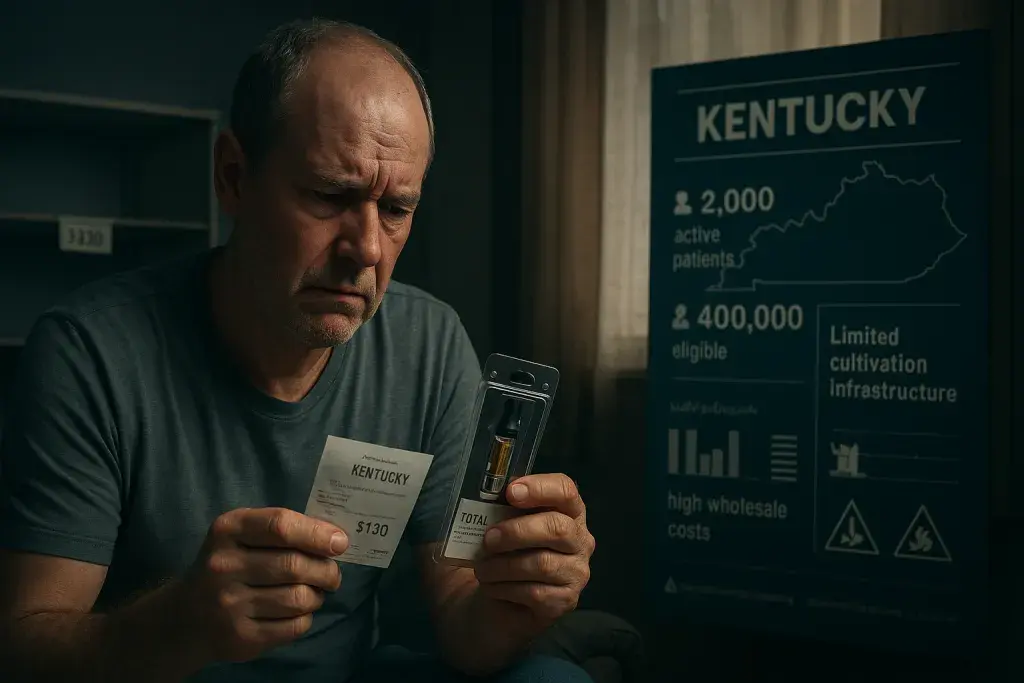
Kentucky's medical cannabis program lost a critical safety valve on July 1, when an executive order expired that had allowed patients to travel out of state and purchase cannabis under conditional pardons. Now that those protections are gone, patients are required to buy inside Kentucky - and what they're finding on dispensary shelves is sticker shock. A one-gram vape cartridge that retails for $24 across the border in Metropolis, Illinois can run $130 at a Kentucky dispensary. That isn't a rounding error. That's a structural market problem.
The math behind that gap isn't mysterious, even if it's cold comfort for patients paying out of pocket - medical insurance doesn't cover cannabis, full stop. Kentucky's dispensaries only began operating in late 2025, just 17 are open statewide, and the cultivation and processing infrastructure to support competitive wholesale pricing simply doesn't exist yet. More mature markets - Illinois, Michigan, and others among the five surrounding states that had medical programs before Kentucky - have had years to build out production capacity, drive down wholesale costs per unit, and let retail pricing follow. For a deeper look at how early-stage regulated markets move through this pricing curve, read more about how other limited-license states have handled similar pressures. Kentucky is at the beginning of that arc, not the middle, and patients are absorbing the cost of that earliness directly.
Sam Flynn, Deputy General Counsel in the Kentucky Office of Medical Cannabis, testified to the Interim Joint Committee on Agriculture that prices will compress as more cultivating and processing facilities come online. That's accurate as a general principle - supply-side expansion does push wholesale menus down, and retail pricing follows. But "eventually" doesn't help the patient who's bedridden today. Ricky Hunt, a 60-year-old Hopkinsville resident who has lived with spinal cord damage since childhood, testified by video from home that his out-of-pocket costs for vape products in Kentucky are more than five times what he paid in Illinois. He's not an outlier.
A Thin Cardholder Base on a High Price Floor
As of late June, Kentucky had 26,000 active medical cannabis cardholders. The state's own estimates put the eligible population - those who meet the statutory qualifying conditions - at roughly 400,000. That gap matters commercially. Thin patient volume means dispensaries can't move enough units to drive down per-unit operating costs. Low throughput across 17 locations statewide also limits what processors and cultivators can justify investing in capacity. The result is a market caught in its own bottleneck: high prices suppress card adoption, low card adoption suppresses demand, and suppressed demand gives producers little incentive to scale aggressively.
Rachel Roberts, Executive Director of the Kentucky Cannabis Industry Alliance, framed it plainly before the committee: without expanding access, the high price floor will continue. Her organization is pushing for several structural reforms - telehealth consultations to replace the current mandatory in-person physician visit, physician discretion in recommending cannabis rather than strict adherence to a qualifying-condition list, elimination of the notary requirement for patient applications, and eased advertising restrictions. Each of those is a friction point that adds cost or reduces patient volume. Removing them wouldn't instantly bring Kentucky to parity with Illinois or Michigan, but they'd widen the funnel and give the supply chain more reason to invest.
The Compliance Calculus - and the Diversion Risk
Here's where it gets complicated for operators and regulators simultaneously. Committee Co-Chair Rep. Myron Dossett, a Republican from Pembroke, said out loud what the pricing data implies: if legal cannabis in Kentucky costs five times what it costs across the state line, some patients will go to the unregulated market. That's not speculation - it's basic consumer behavior, and it's a pattern every early-stage regulated cannabis market has had to contend with. Diversion from unregulated sources isn't just a public-safety concern; it's a compliance and market-integrity problem that reflects directly on licensed operators trying to build credible businesses.
Roberts noted that products moving through Michigan's high-volume market - where gummies can sell for two or three dollars - aren't subject to the same testing standards Kentucky mandates for its licensed supply chain. That's a real distinction. Kentucky-licensed products carry COAs from in-state testing, meet the packaging and labeling standards the legislature put in place, and pass through seed-to-sale tracking. That compliance infrastructure has cost - it's baked into every unit price on the shelf. The honest challenge is communicating that value to patients who are watching their out-of-pocket costs stack up with no insurance offset and limited dispensary options within driving distance.
What Operators and the Industry Should Watch
For dispensary operators in Kentucky, the near-term picture is constrained but not static. Advocacy from the Kentucky Cannabis Industry Alliance is aimed at the levers most likely to move patient volume - access reforms that reduce barriers to getting a card in the first place. More cardholders means more transactions, and more transactions give operators room to optimize their retail operations, manage inventory shrinkage more efficiently, and eventually work with processors on more competitive wholesale pricing. Seventeen dispensaries for a state the size of Kentucky is a thin footprint; that number will grow, and each new location adds competitive pressure that benefits pricing over time.
The advertising restrictions Roberts flagged are also worth watching from a B2B standpoint. Restricted advertising doesn't just limit consumer awareness - it limits the ability of licensed operators to distinguish their compliant, tested products from unregulated alternatives. That's a market-positioning problem as much as a regulatory one. If Kentucky's legislature acts on any of the Industry Alliance's reform priorities, the dispensaries that have already built out their POS systems, compliance workflows, and patient intake processes will be best positioned to absorb a surge in new cardholder volume. The infrastructure investment matters now, even when transaction counts are still modest.