State compliance data from multiple legal cannabis markets tells a remarkably consistent story: licensed marijuana retailers are blocking minors from purchasing their products at rates that meet or exceed those of the alcohol industry. Data from California, Colorado, Washington, and other states show compliance rates ranging from 94 to 100 percent - figures that should reshape the debate over whether regulated cannabis markets can effectively keep products away from young people.
The Numbers, State by State
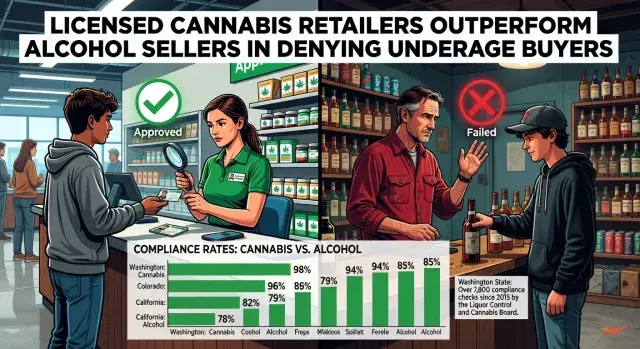
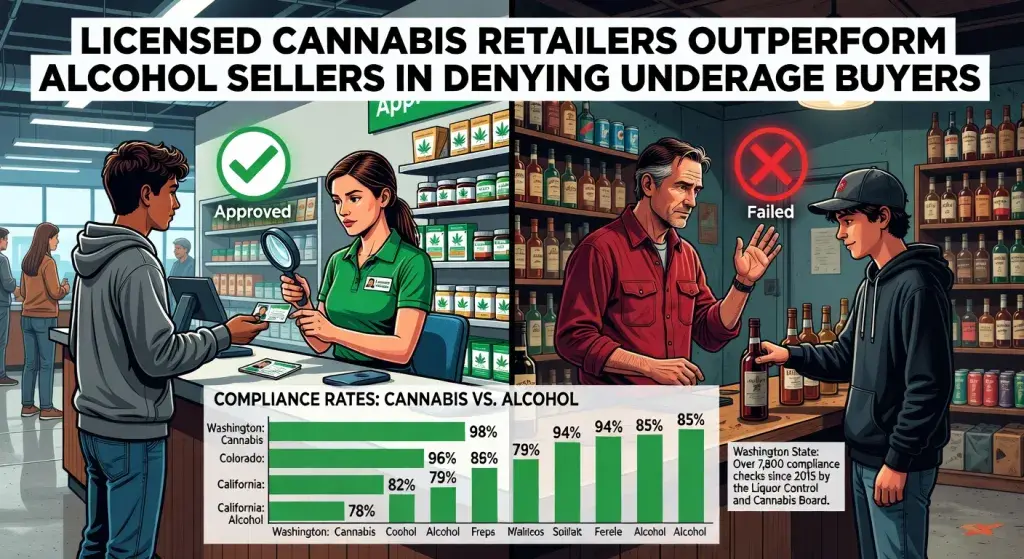
Washington State offers perhaps the most granular look. The state's Liquor Control and Cannabis Board has conducted more than 7,800 compliance checks of licensed cannabis establishments since 2015. These aren't passive surveys - they're controlled purchase attempts using patrons between the ages of 18 and 20. In over 94 percent of cases, minors were turned away. That's a strong number on its own. But here's what makes it striking: during the same period, underage patrons attempting to buy alcohol were denied access only 81 percent of the time.
Cannabis retailers, in other words, are outperforming bars and liquor stores on the very metric that critics said they'd fail.
Colorado's numbers are even more lopsided. Data provided by the state government in 2023 found that underage operatives were denied access to retail cannabis products 99 percent of the time. A 2022 inspection study in California reported that marijuana businesses were "100 percent" compliant with ID verification requirements. The study's authors were blunt in their conclusion: "Underage youth are not obtaining marijuana at licensed recreational outlets."
Peer-Reviewed Evidence Points the Same Direction
This isn't just regulatory self-reporting. A study published in the Journal of Studies on Alcohol and Drugs assessed retailer compliance across California, Colorado, and New Mexico and reached a conclusion that would have seemed implausible a decade ago: "Compliance with laws restricting marijuana sales to individuals age 21 years or older with a valid ID was extremely high and possibly higher than compliance with restrictions on alcohol sales." Separately, point-of-sale audits of randomly selected retailers in Denver, Los Angeles, Las Vegas, and Seattle reported near-total compliance.
Why the gap between cannabis and alcohol? A few factors likely contribute. Cannabis retailers operate under newer, tighter regulatory frameworks with steep penalties - including potential loss of a license that may have cost hundreds of thousands of dollars to obtain. The licensing process itself selects for operators who take compliance seriously; there are no grandfathered-in corner stores. And the political reality is plain: cannabis retailers know that every violation feeds the argument for prohibition. The incentive structure, to put it plainly, is punishing.
Youth Use Is Declining, Not Rising
The compliance data gains additional weight alongside broader trend lines. Federally funded survey data compiled by the University of Michigan in December reports that adolescent marijuana use has fallen significantly since states began regulating adult-use markets. Current rates now stand at or near historic lows. That finding cuts against one of the most persistent objections to legalization - the notion that legal markets would function as a gateway, normalizing use among teenagers and driving consumption upward.
The opposite appears to be happening. And the mechanism isn't mysterious: illicit dealers don't check IDs. Licensed retailers, subject to regular audits and facing real financial consequences, almost always do.
What This Means for the Policy Debate
NORML's Deputy Director Paul Armentano put it succinctly: "Regulation works. Illicit marijuana providers don't ask for or check for ID, but licensed businesses most certainly do." He added that the real-world experience of legal states "affirms that it is being implemented in a way that provides regulated access for adults while simultaneously limiting youth access and misuse."
None of this means the system is perfect. A 94 percent compliance rate in Washington still means roughly one in sixteen checks results in a sale to a minor - a number worth driving lower. But the direction is clear, the data is consistent across jurisdictions, and the comparison with alcohol - a substance whose regulation is rarely questioned as a matter of principle - is difficult to dismiss. For legislators in states still debating legalization, these numbers represent something concrete: evidence that a regulated market can do what the black market never could.