Georgia's medical cannabis program is a decade old, serves more than 33,000 approved patients, and still restricts patients to low-THC oil products that operators say fall well short of what the broader licensed market provides. At a study committee meeting held at Mercer University in Macon, lawmakers and medical cannabis advocates sat down to examine whether - and how - the state's policy framework should expand. The central pressure point: a THC cap that one dispensary operator argues is making Georgia an outlier among states with functioning medical programs.
A Program With Real Infrastructure, Limited by Policy
The supply side of Georgia's medical cannabis market is unusually constrained. Roughly ten licensed dispensaries operate across the state, but only three facilities are authorized to produce the product. That ratio - one production facility for every three or four retail outlets - creates supply chain strain that no point-of-sale system or inventory management software can fix. It's a structural problem, not an operational one.
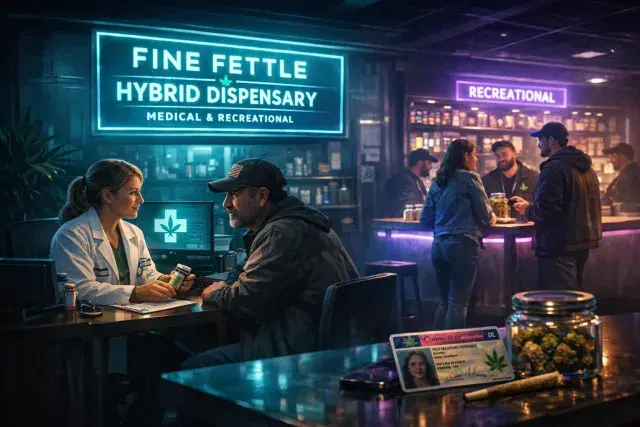
Fine Fettle, based in Macon, is one of those three licensed producers. Its president, Judson Hill, was among those speaking with lawmakers, and his position was direct: the current THC percentage limit prevents Georgia's program from delivering the product strengths patients in other states routinely access. "Forty states across the country already have medical cannabis now," Hill noted, "and our program is still a low THC oil program that doesn't offer the products and the strength that the patients of Georgia needs."
That's not a retail complaint - it's a licensing and regulatory constraint with direct downstream consequences for operators, patients, and the economics of the program itself. A licensed producer building out cultivation, extraction, and processing infrastructure is working against a ceiling that limits both its product catalog and its addressable market.
Why THC Caps Matter to Dispensary Economics
For dispensary operators in states with potency restrictions, the effect on SKU management and wholesale pricing is real. When a state caps allowable THC concentration - particularly in oil-based formulations - licensed retailers cannot stock the product formats or potencies that patients may have used in other states or discussed with their physicians. That narrows the menu, compresses the range of retail price points, and makes it harder for operators to build the kind of patient retention that keeps a medical dispensary economically viable.
There's also a competitive pressure that doesn't get discussed enough: patients who hold Georgia's medical cannabis card but live near a state border, or who travel, encounter programs with broader product access. That comparison shapes patient expectations - and, in a small licensed market with capped production, it affects whether patients stay engaged with the program at all.
Vertical integration, which Fine Fettle appears to operate under given its dual role as producer and retailer, does provide some insulation - but only to a point. When the regulatory ceiling limits what can legally be produced, no amount of operational efficiency changes the output.
The Legislative Posture: Careful, Not Fast
State Representative Mark Newton was unambiguous about the committee's approach. "We need time to study more in depth before we make policy," he said, pointing out that Georgia has allowed medical cannabis since 2015 - a timeline that suggests deliberateness, not urgency, is the governing instinct. Representative Robert Dickey echoed the measured tone, acknowledging the program's potential while noting that limited prior research, a consequence of the product's federal classification, has slowed the evidence base that typically informs state-level policy.
Fair enough - there's something reasonable about a legislature not rushing a controlled-substance expansion without review. But for operators holding licenses, building facilities, managing seed-to-sale compliance requirements, and staffing dispensaries, the pace of policy movement has direct financial consequences. Capital decisions don't pause for study committees. Production timelines don't either.
What the committee's framing does signal, at minimum, is that sweeping changes to Georgia's medical cannabis framework aren't imminent. Operators and investors in the state should expect incremental movement - if any - before the next legislative session produces actionable policy.
What Operators and Industry Stakeholders Should Watch
For licensed businesses operating in Georgia, or those evaluating market entry, a few realities define the current environment:
- Production licenses remain scarce - three operating facilities for a patient base exceeding 33,000 represents a supply-side constraint unlikely to resolve without deliberate policy action or new licensing rounds.
- THC limits are the immediate policy target for operators, but any change would require the legislature to revisit the framework that has governed the program since 2015.
- Georgia's program remains structured as a medical-only, low-THC oil market - operators cannot plan for adult-use expansion, retail format diversification, or higher-potency product lines without explicit legislative and regulatory authorization.
- Compliance infrastructure still matters: even within current constraints, licensed producers and dispensaries must maintain accurate inventory records, meet packaging and labeling requirements, and operate within the bounds of state-issued licenses.
The meeting in Macon didn't produce a policy outcome. What it did produce is a clearer picture of where the pressure is - and who is applying it. Operators like Fine Fettle are now explicitly part of the legislative conversation, making the case that Georgia's program design is limiting patient access in ways that other states resolved years ago. Whether that argument moves a study committee to action is a different question. For now, the program stays where it is.