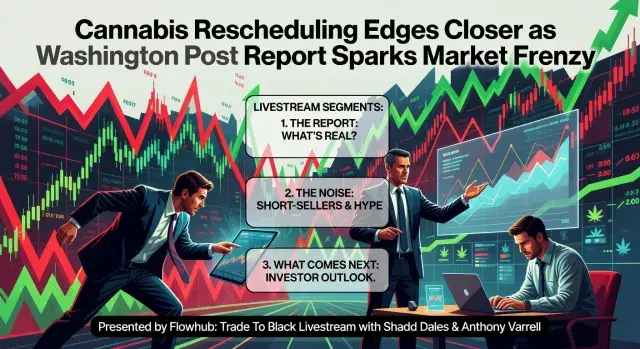
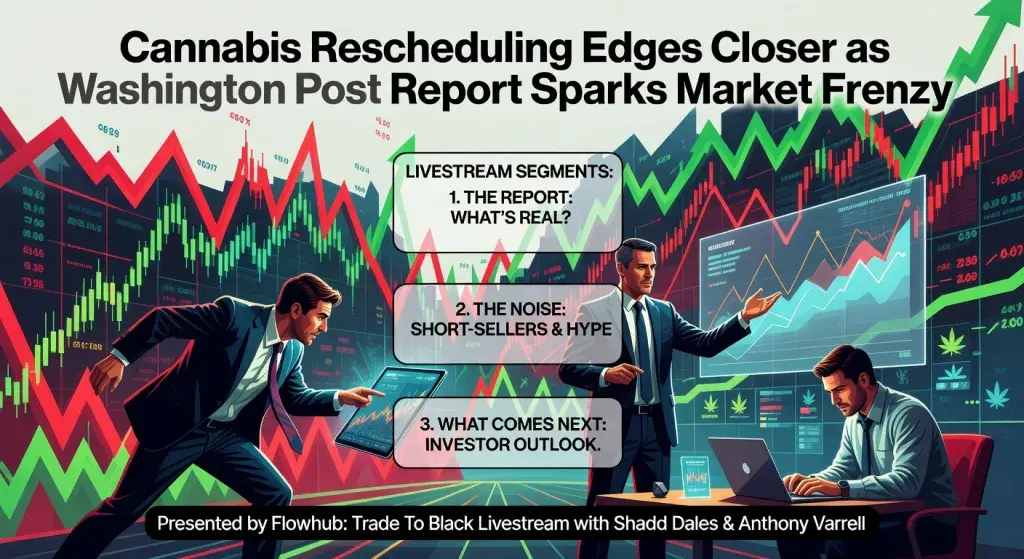
A Washington Post report suggesting cannabis rescheduling may be nearing the finish line sent shockwaves through the sector this week, reigniting a question the industry has been asking - and getting burned by - for years. On the latest Trade To Black livestream, presented by Flowhub, hosts Shadd Dales and Anthony Varrell pulled the story apart across three segments, bringing in a short-seller turned cannabis investor, an ETF chief executive, and a dispensary tech CEO to make sense of what's real, what's noise, and what comes next.
The Rescheduling Signal - and Two Paths Forward
Political analyst and industry insider Marc Cohodes appeared in the first segment with a specific claim: a source close to the Trump administration had told him Wednesday would be the day for a rescheduling announcement. That alone would have been enough to move markets. But Cohodes went further, outlining two distinct procedural routes the administration could take.
The first - and faster - option involves a 1961 international drug treaty mechanism that could, in theory, bypass the standard administrative hearing process entirely. The second is the more conventional path: an administrative law judge hearing that carries greater legal durability but would drag the timeline out considerably. The fast-track route sounds appealing. Here's the catch: speed and legal resilience tend to pull in opposite directions in federal rulemaking, and any shortcut invites litigation from opponents who'd love nothing more than a procedural defect to hang a challenge on.
Whether this particular signal bears out or not, the fact that named sources are publicly discussing specific timing and specific procedural strategies represents a different tenor than earlier rounds of rescheduling speculation. Or maybe it doesn't. This industry has been here before - close enough to taste it, only to watch the window close.
Market Action and the Ghosts of December 18
The second segment pivoted to the money side, and for good reason. Noah Hamman, CEO of AdvisorShares and the person who manages both the MSOS and YOLO cannabis ETFs, joined to discuss the day's price action. MSOS posted volume north of 55 million shares - a significant surge by any measure. But Hamman was careful not to get ahead of the facts. Nothing had been filed. Nothing had been confirmed. Headlines were encouraging; filings were absent.
Dales set that caution in a useful historical frame. On December 18, when Donald Trump signed an executive order related to cannabis, the sector was aggressively shorted. Retail investors holding short-dated options - the most fragile position in a volatile sector - got caught on the wrong side. It was a painful reminder that cannabis stocks can move violently on news and then give it all back just as fast. Hamman's view was measured: even after the day's rally, the underlying stocks likely remained below fair value. That's a bullish read, but a patient one.
The implicit message to investors was plain enough - if rescheduling does materialize, the upside could be substantial, but positioning matters enormously, and getting whipsawed by premature conviction is a real risk.
4/20 Sales Data Shows an Industry Still Growing
Flowhub CEO Kyle Sherman closed the show with something more concrete than Washington speculation: actual sales numbers from April 20, the cannabis industry's de facto annual holiday. Overall volume came in roughly 12 to 15 percent above the prior year, with analysts projecting industry-wide sales between $400 and $430 million for the single day. Those are meaningful numbers - not just as a cultural barometer but as evidence that consumer demand continues to grow even as regulatory uncertainty persists.
Sherman also weighed in on the Axios report covering rescheduling, but his real value-add was operational. For dispensary operators coming off one of the biggest revenue days of the year, the question isn't just whether Washington delivers - it's whether the underlying business fundamentals support the current trajectory. The 4/20 data suggests they do, at least for now.
So - Are We Actually Close This Time?
That was the question hanging over all three segments, and nobody offered a definitive answer. Which is, frankly, the honest position. The procedural paths exist. The political will appears stronger than it has in previous cycles. Market participants are cautiously positioning for upside. And consumer demand keeps climbing. But "close" in cannabis policy has a long and painful history of meaning "not yet." The distance between a Washington Post report and a Federal Register filing is measured not in miles but in bureaucratic will, legal exposure, and political timing. The industry is watching. It just knows better than to hold its breath.