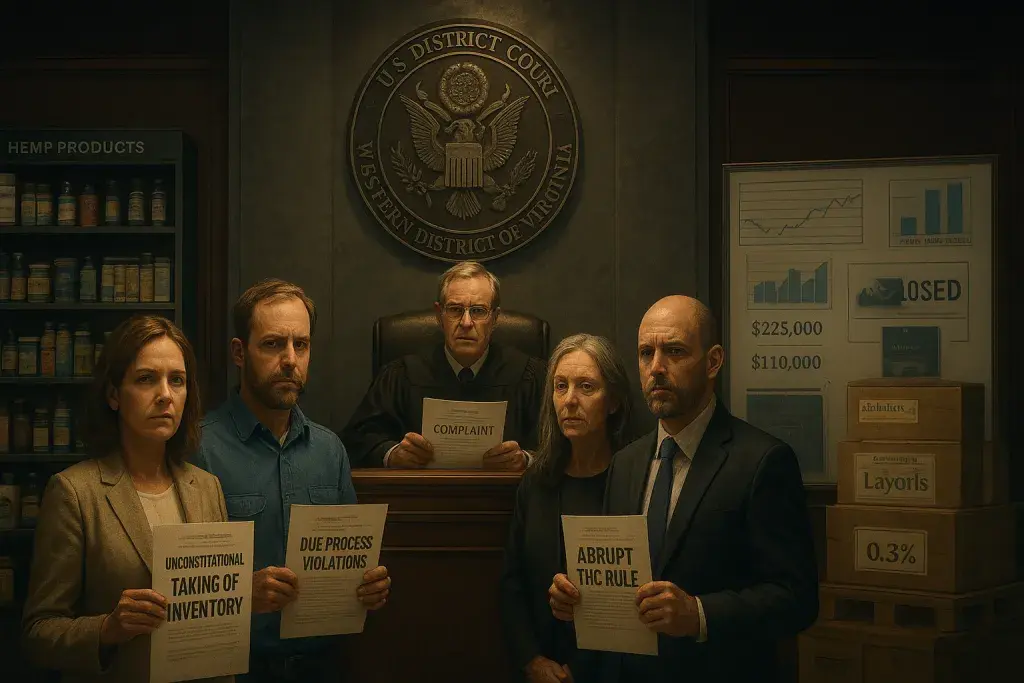
Seven Virginia hemp businesses filed suit July 31 in the U.S. District Court for the Western District of Virginia, seeking to block a budget provision that eliminates a long-standing exception allowing consumable hemp products to contain more than 2 milligrams of total THC per package when paired with at least 25 times as much CBD. Without that carve-out, products sold statewide must fall within 2 mg of total THC per package and stay under the 0.3 percent total THC concentration threshold set by state law. The rule takes effect August 15, and the plaintiffs say roughly 40 days of notice left no realistic path to reformulate products, redesign packaging, or renegotiate manufacturing contracts.
That compressed timeline is the crux of the legal argument. The businesses - including District Hemp Botanicals, Nova Hemp & Agriculture, Redfern Hemp Co., Pure Elkton Manufacturing, Cypress Hemp II, Wellness Warriors and Simply Hemp - contend the change amounts to an unconstitutional taking, and violates due process and equal protection guarantees, since inventory built and financed under the old framework now faces mandatory destruction with no compensation mechanism. For operators watching compliance costs shift overnight, the episode is a reminder of how fast a regulatory environment can move; retailers in other tightly regulated markets have faced similar whiplash, which is part of why point-of-sale infrastructure matters so much. Systems like POS software for Texas cannabis retailers have had to adapt quickly as states redefine allowable THC thresholds, underscoring how compliance technology and inventory management are no longer back-office concerns but front-line survival tools.
Inventory, Layoffs and the Cost of No Transition Period
The dollar figures in the complaint vary by company but tell a consistent story. Cypress Hemp says the affected product category represents about 95 percent of its revenue. Redfern Hemp estimates losses between $110,000 and $115,000. Simply Hemp projects roughly $225,000 in lost revenue this year and expects to close its Collinsville location. District Hemp Botanicals, founded by plaintiff Barbara Biddle, reports about $10,000 in soon-to-be-unsellable inventory against more than $181,000 in outstanding obligations to creditors - the kind of balance sheet mismatch that turns a regulatory change into a solvency crisis. Biddle has already reduced staff and expects to terminate her Leesburg store lease. Nova Hemp's Travis Lane described pallets of hemp-derived beverages built for statewide distribution that may become unsellable overnight, calling them "a sitting duck" under the new limit.
Why Virginia Moved and What Comes Next
State officials argue the exception had become a loophole, letting intoxicating hemp products reach convenience stores and vape shops without the testing, packaging and age-verification controls applied to licensed marijuana dispensaries. The Spanberger administration frames the change as consumer protection, pointing to gaps in oversight and enforcement tools for the illicit market. Attorney General Jay Jones has signaled his office will defend the law. The businesses counter that Virginia's existing hemp framework - adopted in 2023 under then-Sen. Emmett Hanger - already required child-resistant packaging, independent lab testing, warning labels and a minimum purchase age of 21, and that the new standard ignores concentration, serving size and intoxicating effect in favor of a blunt total-THC cap.
A Market Caught Between Two Regimes
The deeper tension is timing. Virginia's regulated adult-use marijuana market, overseen by the Virginia Cannabis Control Authority, isn't scheduled to open for retail sales until July 1, 2027. That leaves nearly two years where hemp businesses face sharply tighter limits while a licensed alternative doesn't yet exist - a gap Marijuana Justice's Chelsea Higgs Wise says Virginia has not adequately explained to consumers or communities. Other states have taken divergent paths: California banned detectable THC in food and beverages, Minnesota built a regulated hemp-beverage market with per-serving limits, and Texas moved to prohibit delta-8 and related isomers outright. Federal rules are tightening too, with a 0.4 mg per-container THC limit for hemp products set to take effect in November under recent legislation, though the White House has since asked Congress to preserve access to full-spectrum CBD. For operators, the lesson is that compliance frameworks built around THC ratios rather than concentration and dosage are proving legally and politically unstable - and inventory planning now has to account for that volatility.