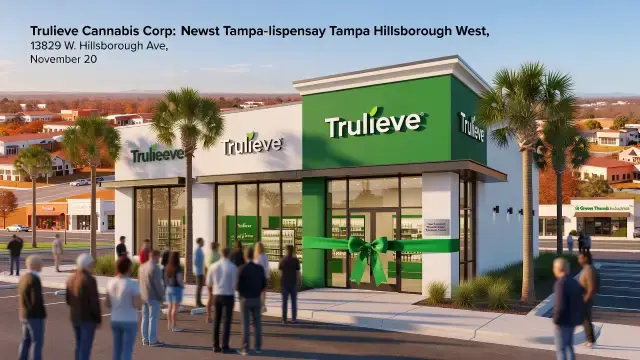
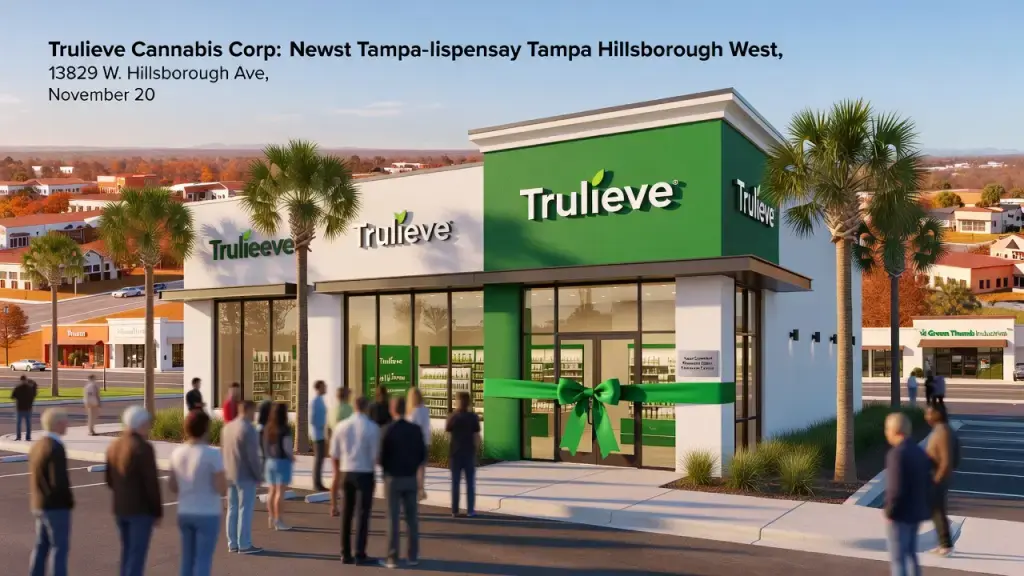
Trulieve Cannabis Corp. has added a 170th-and-counting storefront to its Florida medical cannabis network, with a new location in Tampa set for a grand-opening celebration on Nov. 20. The announcement, made Monday, describes Tampa Hillsborough West at 13829 W. Hillsborough Ave. as already open for walk-in and express pickup service - though the company has not specified when the first sale actually occurred.
That distinction matters more than it might seem. A grand-opening date and a first-sales date are not the same thing in regulated cannabis retail, where a location can receive dispensing authorization and quietly begin transactions well before any ribbon-cutting. Operators often stagger the two for staffing, inventory, or marketing reasons. Readers tracking store counts should treat the celebration date as a promotional marker, not a regulatory one.
What the State's Numbers Actually Show
Florida's Office of Medical Marijuana Use publishes a weekly dispensing-location count, and its Nov. 6 report put Trulieve at 170 locations statewide, out of 789 total dispensing locations operated by all licensed medical marijuana treatment centres. The state also reported 943,905 qualified patients holding active identification cards as of that date. Those figures establish a baseline - but they predate Monday's Tampa announcement, and neither the state table nor the company release confirms whether the new store pushes Trulieve past 170 or simply replaces a closure elsewhere in the count. Assuming simple addition would be guesswork, not reporting.
Under section 381.986 of the Florida Statutes, a medical marijuana treatment centre must hold separate cultivation, processing and dispensing authorizations before it can sell to patients. Vertical integration is effectively mandatory in Florida's model - a structural choice that shapes how companies like Trulieve build out retail. There's no wholesale market of independent processors supplying independent retailers the way there is in some adult-use states; the same company typically grows, processes and sells under one roof, or one brand umbrella.
A Retail Business That Leans Hard on Stores
Trulieve's own numbers underline how dependent the company is on its dispensary network. In its Nov. 5 financial report, retail accounted for 95 per cent of third-quarter revenue of US$230 million, with operating cash flow of US$74 million and cash on hand of US$327 million at Sept. 30. That's a business model built on foot traffic and repeat patient visits, not wholesale distribution deals. Each new store is a direct lever on top-line revenue, and store-count growth remains one of the clearest signals investors and competitors watch.
Separately, Trulieve said it had received final DEA registrations covering its state-licensed medical marijuana dispensaries - a federal registration process that runs alongside, not instead of, state licensing. The two tracks are often conflated by outsiders, but they serve different regulatory purposes and neither substitutes for the other.
Competitors Are Building Too
Trulieve isn't alone in expanding its Florida footprint. Green Thumb Industries reported 27 Florida retail locations as of Nov. 4, following openings in Cape Coral, Belleview and Mulberry, with Florida accounting for five of nine dispensaries the company opened in the third quarter and afterward. That parallel buildout suggests Florida's medical market still has room multiple operators are willing to chase, even with 789 existing dispensing locations already serving the state's patient base.
For landlords, wholesalers and compliance vendors watching the sector, the pattern is familiar: store growth continues even as individual openings generate more questions than headlines answer. A celebration date tells the public a location exists. It doesn't tell anyone when the cash register actually started ringing, what the build-out cost, or how the location performs against the company's broader retail base - details that matter far more to operators and investors than the ribbon-cutting itself.