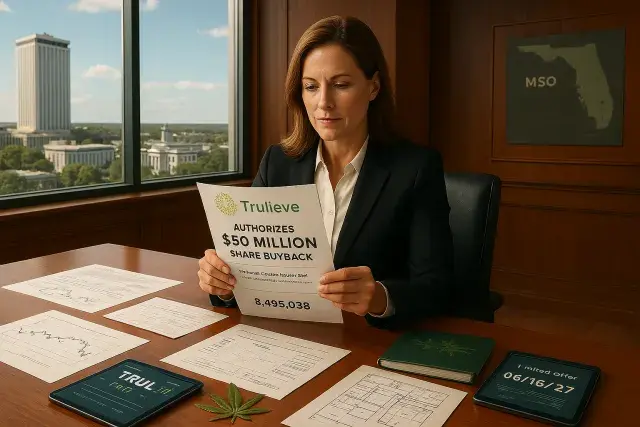
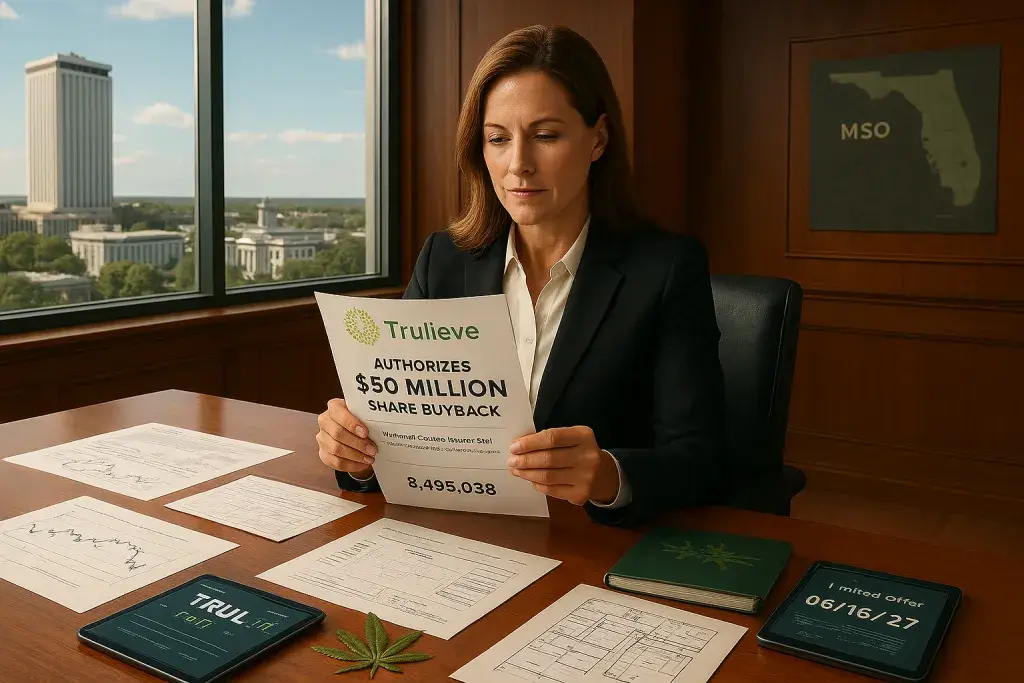
Trulieve Cannabis Corp. has authorized a share repurchase program of up to $50 million - or up to 5% of its issued and outstanding subordinate voting shares, whichever is smaller - over the next 12 months. The program, approved by the company's board and announced from its Tallahassee headquarters on June 9, 2026, expires June 16, 2027. Any shares acquired under the program will be canceled, not held in treasury.
For investors and multi-state operator watchers, the mechanics here are worth understanding. A buyback authorization is not a purchase commitment - the company can suspend, modify, or walk away from the program at any time. What it does signal is that Trulieve's board views its current share price as an undervalued entry point relative to the company's intrinsic worth. That's a specific claim with real capital behind it. CEO Kim Rivers framed it as disciplined capital allocation rather than opportunistic maneuvering, positioning share repurchases alongside balance sheet investment and growth spending. For operators tracking how larger licensed cannabis businesses manage equity - and for technology vendors supplying tools like a cannabis pos system california operators depend on to run compliant retail floors - watching how MSOs deploy excess capital remains a useful proxy for overall sector confidence.
The program will be executed in accordance with applicable securities laws. Because Trulieve is a Canadian Securities Exchange-listed company with U.S. operations, its share repurchase activity sits under a dual regulatory framework - Canadian securities rules govern the structure of the Normal Course Issuer Bid, while U.S. securities law constrains the timing and volume of open-market purchases. That's not a simple compliance overlay. It requires careful coordination to avoid running afoul of either regime, particularly around blackout periods and reporting obligations.
What a Buyback Actually Means in the Cannabis Capital Context
Cannabis companies don't operate in the same financial environment as conventional retailers. Section 280E of the U.S. Internal Revenue Code - which disallows standard business deductions for companies trafficking in federally controlled substances - compresses margins at the operator level in ways that make capital allocation decisions materially harder than in any comparably sized consumer goods business. Cash that might otherwise fund expansion or debt reduction carries a heavier tax drag to accumulate in the first place.
Against that backdrop, authorizing a share repurchase is a statement. It says the company has sufficient liquidity and cash generation to return capital to shareholders without compromising operational needs. For Trulieve specifically, which built its position through vertical integration across cultivation, processing, and retail in Florida before expanding to other markets, that operational base provides the cash flow foundation the program rests on.
The thing is, a $50 million ceiling on a buyback program is meaningful in cannabis but would register as routine in most mainstream retail sectors. It reflects where the industry still sits in terms of access to conventional capital markets, institutional ownership, and balance sheet flexibility. The program's 5% share cap - set at 8,495,038 subordinate voting shares as of June 8, 2026 - is also a standard ceiling under Canadian securities exchange rules for issuer bids of this type. Nothing unusual there structurally. The signal is in the decision to use the tool at all.
Implications for Operators and the Broader MSO Sector
Dispensary operators and wholesale suppliers watching Trulieve's moves should read this as a confidence indicator, not a strategic pivot. The company isn't announcing market exits, facility closures, or wholesale menu contractions. Rivers explicitly linked the program to long-term business value - which, in practical terms, means management believes its retail footprint, supply chain infrastructure, and licensing position justify a higher share price than the market is currently assigning.
For smaller operators and B2B vendors in the cannabis supply chain, the broader takeaway is about market maturation. When a leading MSO deploys a formal share repurchase mechanism - complete with board authorization, securities-compliant execution, and a defined expiration date - it reflects a business operating with the governance discipline of a conventional public company, not a startup navigating early licensing. That shift has downstream effects: it raises the bar for reporting standards, investor expectations, and operational transparency across the sector.
What it doesn't change, at least in the near term, is the regulatory and tax environment that constrains every licensed cannabis business in the U.S. The 280E burden remains. State-level excise taxes and licensing costs haven't moved. The capital markets access problem that defines cannabis finance hasn't been solved by any single corporate action. A buyback program is a tool - and, in Rivers' own framing, one deployed when market conditions present a compelling opportunity. Whether those conditions persist through June 2027 is an open question.