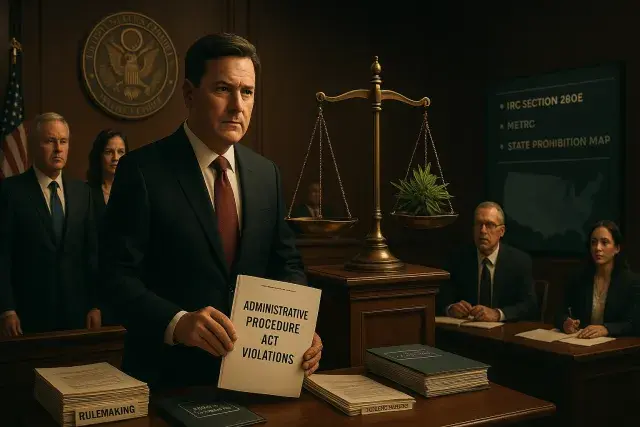
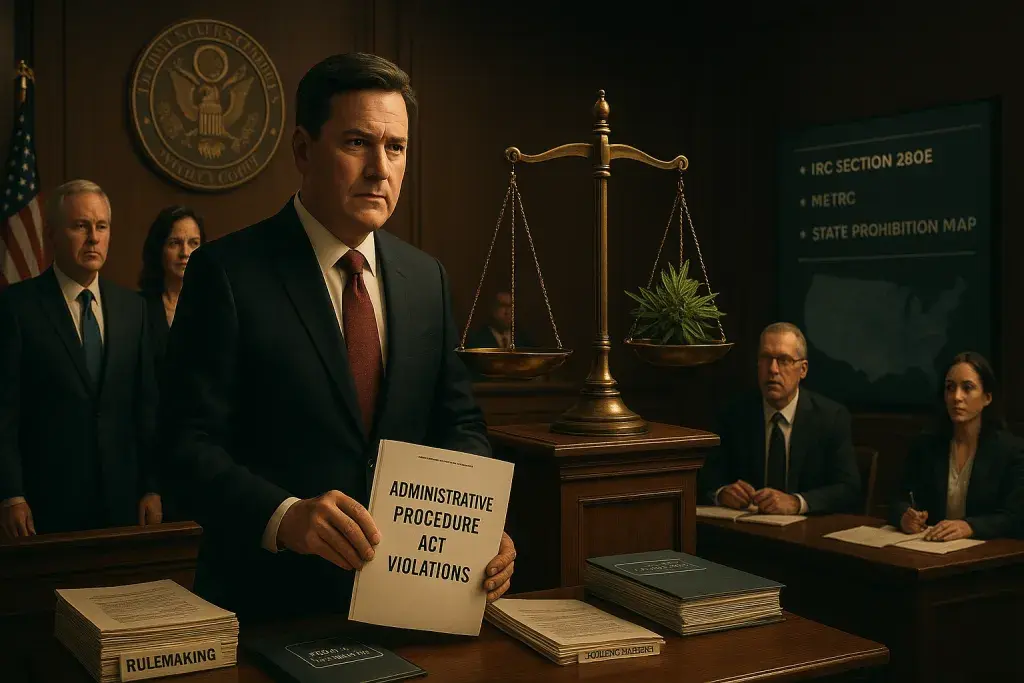
Indiana Attorney General Todd Rokita has joined his counterparts in Nebraska and Louisiana in a federal lawsuit seeking to stop the U.S. Department of Justice from moving marijuana from Schedule I to Schedule III under the Controlled Substances Act. The suit names Acting U.S. Attorney General Todd Blanche and the Drug Enforcement Administration as defendants, arguing that federal agencies failed to follow required rulemaking procedures. For operators, investors, and compliance professionals watching the rescheduling process, this legal challenge introduces real uncertainty into a regulatory shift that was already months behind expectations.
What the Lawsuit Actually Argues
The core claim is procedural, not philosophical. The plaintiff attorneys general are not simply arguing that marijuana should stay Schedule I on policy grounds - they are arguing that the DOJ and DEA did not follow proper administrative procedure in advancing the rule change. That distinction matters. A successful procedural challenge could force agencies to restart or substantially revise the rulemaking process, adding significant delay without necessarily resolving the underlying policy question.
Rulemaking under the Administrative Procedure Act requires agencies to publish proposed rules, accept public comment, and respond substantively to those comments before finalizing any change. If the court finds those steps were inadequately completed, the rescheduling effort doesn't die - it goes back. In practice, though, that kind of reset can take years, particularly when a new administration may have different priorities around how aggressively to defend the rule in court.
Why Prohibition-State AGs Are Driving This Challenge
Indiana is one of roughly ten states that have not authorized either medical cannabis programs or adult-use sales. That puts it in a shrinking category - and the political pressure that comes with being surrounded by states that have moved in the other direction creates its own dynamics. Rokita's participation signals that at least some state-level officials see rescheduling itself, not just legalization, as a threat to their legal and enforcement posture.
Here's the underlying tension: Schedule III status does not legalize marijuana at the federal level. Dispensaries in adult-use or medical states would not suddenly gain access to FDIC-insured banking, resolve their 280E tax burden, or see interstate commerce open up simply because the DEA changed a scheduling number. But rescheduling would formally acknowledge medical utility - a concession that prohibition-state officials appear reluctant to make, because it complicates the legal and political argument for maintaining complete bans at the state level.
What's striking is that the most immediately consequential federal change for operating cannabis businesses - relief from IRC Section 280E, which currently bars licensed cannabis operators from deducting standard business expenses - hinges on whether marijuana is a Schedule I or II substance. A move to Schedule III would remove cannabis businesses from 280E's scope entirely. That's not a minor accounting footnote; for dispensary operators running on thin margins, 280E can represent an effective tax rate dramatically higher than comparable retail businesses pay. The lawsuit, if successful, would keep that burden in place.
Operational and Compliance Implications for Licensed Operators
Licensed cannabis businesses - particularly multi-state operators and those in states with active regulatory frameworks - have been watching the rescheduling timeline as a proxy for broader federal normalization. Rescheduling was expected to ease, even modestly, the compliance friction that comes from operating in a federally illegal environment: the difficulty of securing business banking, the limitations on payment processing, the reluctance of some landlords and insurers to work with plant-touching companies.
A court injunction blocking rescheduling, or a drawn-out legal battle that leaves the rule in legal limbo, doesn't change day-to-day dispensary operations - METRC compliance obligations, state-level licensing requirements, seed-to-sale tracking, and compliant packaging rules all remain under state jurisdiction regardless of federal scheduling. But it does affect the longer arc of normalization that operators, investors, and payment technology providers have been pricing into their business planning.
For cannabis payment technology vendors and financial institutions that have been gradually expanding services to the industry, continued Schedule I status means continued exposure to federal risk classifications that make broad banking participation difficult. Cashless payment solutions built on workarounds - PIN debit structures, closed-loop systems - remain necessary infrastructure precisely because federal scheduling keeps traditional banking participation constrained.
The Broader Regulatory Picture
This lawsuit is one of several legal and political forces bearing on the rescheduling timeline simultaneously. It does not resolve the question of whether rescheduling will happen; it introduces another procedural obstacle in a process that has already moved slowly. The DEA and DOJ will need to defend the rulemaking record in court, and the outcome will depend on whether judges find the administrative process adequate - a legal standard that is fact-specific and not easy to predict.
For cannabis businesses operating today: nothing changes operationally in the short term. State licensing, testing requirements, excise tax obligations, and compliance reporting don't shift with federal scheduling status. The business case for rigorous compliance operations - accurate inventory management, clean audit trails, documented COAs, defensible POS records - remains exactly what it was before this lawsuit was filed. The federal question is real, but it is not the thing that determines whether a licensed operator stays in business next quarter.
What the lawsuit does do is extend the timeline of uncertainty. And in a sector where uncertainty is already the operating condition, that's a pressure operators are well acquainted with.