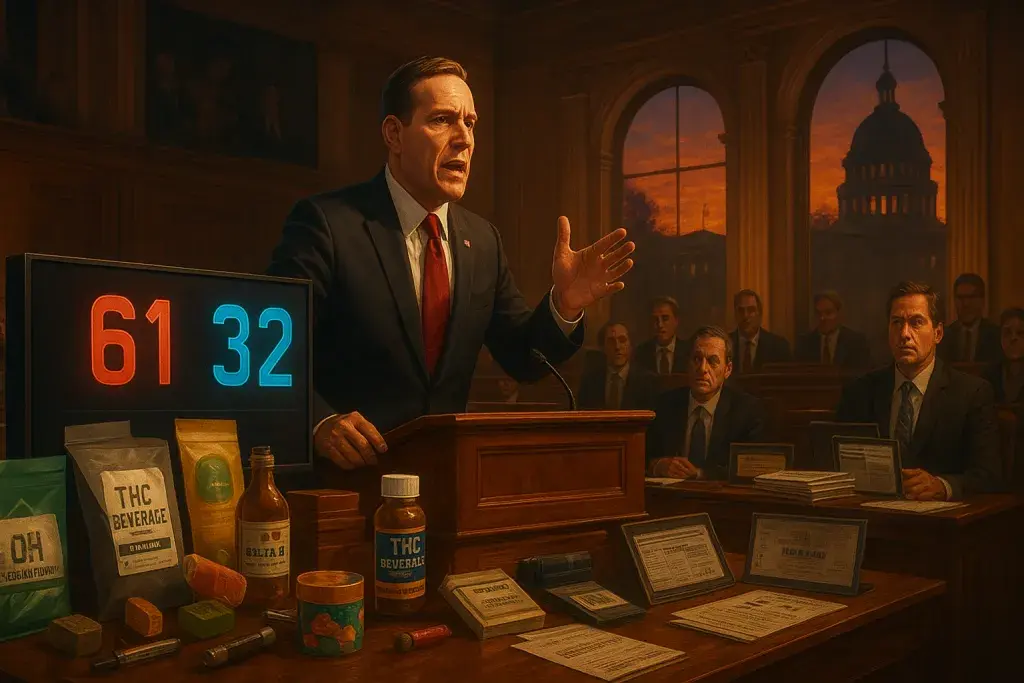
A one-vote-shy-of-two-thirds tally in the US Senate kept a 30-day delay on federal hemp restrictions alive last week, dealing a setback to Sen. Ted Budd, R-NC, and his push to force the changes into effect on schedule. Senators voted 61-32 on Aug. 8 to table Budd's amendment, which would have struck a provision in the continuing resolution pushing the effective date of new hemp THC limits from Nov. 12 to Dec. 11. The vote crossed party lines and exposed a rift among Senate Republicans over how fast to move against a hemp-derived cannabinoid market that has operated with minimal federal oversight since the 2018 Farm Bill.
For operators trying to plan inventory, staffing, and vendor contracts around a moving compliance deadline, the stakes are not abstract. A licensed cannabis retailer in a regulated adult-use or medical market already tracks every gram through seed-to-sale software, reconciles batch numbers against COAs, and files excise tax remittances on a fixed schedule. Hemp-derived intoxicants sold through convenience stores, gas stations, and grocery aisles have largely skipped that infrastructure entirely - no METRC reporting, no licensing fees, no age-verification mandate in most states. That regulatory gap is exactly what the federal law, and now North Carolina's stalled House Bill 328, is aimed at closing. States that already require track-and-trace discipline for THC products, including markets running platforms like Metrc-compliant POS for Oklahoma, offer a preview of what compliance-heavy hemp regulation could eventually look like nationwide if Congress and state legislatures settle on a unified standard. Metrc-compliant POS for Oklahoma
What the Federal Deadline Actually Changes
The underlying law, passed in November 2025, redefines hemp based on total THC content and bars finished hemp-derived products containing more than 0.4 milligrams of combined total THC and similar cannabinoids per container. That threshold is a fraction of what most delta-8 gummies, THC beverages, vapes, and THCA flower products currently carry on convenience-store shelves. Once the restriction takes hold - whether Nov. 12 or Dec. 11 - most of the current intoxicating hemp product catalog becomes federally noncompliant, regardless of state-level hemp licensing. That is a supply-chain problem as much as a policy one: brands built around high-potency hemp beverages and edibles will need entirely new formulations, new lab testing protocols, and in many cases new packaging that does not resemble snack or candy branding, a point Budd raised repeatedly on the floor.
Retailers Caught Between Two Clocks
North Carolina's own legislative stalemate illustrates the operational bind facing multistate hemp sellers. HB 328 cleared the state Senate 37-6 in July but has stalled in the House, where lawmakers remain divided between an outright 0.4-milligram cap and a lighter regulatory touch built around age limits, mandatory testing, and labeling standards. Because the bill would write the THC threshold directly into state law, it would survive even if Congress delays or rewrites the federal standard again - meaning North Carolina retailers could face a stricter, faster-moving compliance deadline than the rest of the country. For convenience stores and smoke shops that never built lab-testing relationships or compliant packaging workflows, that is a costly scramble on short notice, not a paperwork formality.
The Lobbying Fight Behind the Vote
Budd's amendment drew support from 21 Republicans and 11 Democrats, but a coalition of 105 organizations - including the US Hemp Roundtable, the National Association of Convenience Stores, and several North Carolina hemp and brewing groups - lobbied Senate leadership to preserve the delay, arguing it buys time for Congress to legislate good manufacturing practices, import controls on synthetic cannabinoids, and youth-access safeguards rather than eliminate the market outright. The administration, through CMS Administrator Dr. Mehmet Oz, separately warned that abrupt implementation could disrupt access to full-spectrum CBD products for seniors and people with disabilities. Whether that argument holds up under scrutiny is a separate question; what it confirms is that the fight over intoxicating hemp is no longer just a public-health debate. It is now a live regulatory and compliance question for every retailer, distributor, and payment processor touching hemp-derived cannabinoids, with real deadlines attached and very little runway left to prepare.