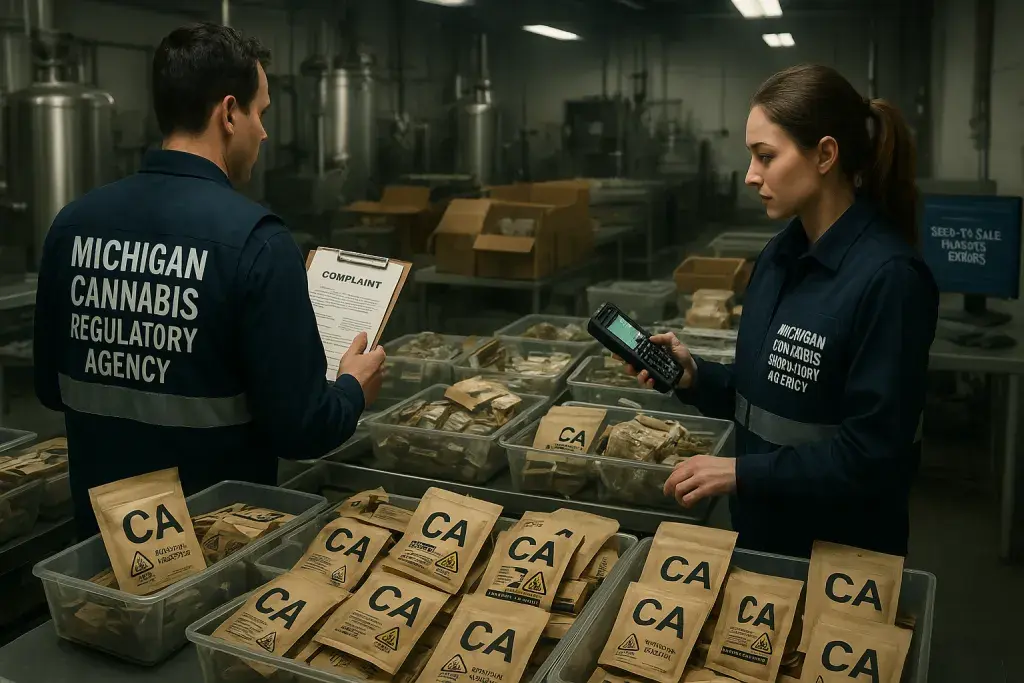
A Michigan cannabis processor is facing potential license suspension after state inspectors found more than 12,000 individual cannabis products with no Metrc tags or identifying information - including items in California-specific packaging that had no business being in a Michigan-licensed facility. The Michigan Cannabis Regulatory Agency filed the formal complaint against VJAS 1, operating out of Harrison Township, following an inspection that raised immediate questions about supply chain integrity and product origin. The case is one of the more flagrant compliance breakdowns documented in Michigan's adult-use market to date.
What makes this situation particularly hard to explain away is the California packaging. Products bearing "CA" labeling and California-mandated consumer warnings don't end up in a Michigan processing facility through paperwork error or inventory mismanagement. Regulated cannabis markets operate on closed-loop tracking systems precisely to prevent this kind of cross-state movement - Metrc being the seed-to-sale platform most state programs, including Michigan's, use to log every transfer, transformation, and sale of licensed product. The absence of Metrc tags on 12,000-plus units isn't a clerical gap; it's a structural failure, or something worse. Operators in other regulated states - whether they run a dispensary, a processing facility, or a delivery operation - should pay attention here. Inventory control isn't just an administrative function; it's what separates a licensed business from a liability. A dispensary pos system maryland operators or processors in any regulated state use should, at minimum, flag untagged units at intake and prevent them from moving through the facility without verified compliance documentation - that's table stakes, not a bonus feature.
Investigators also found products that did carry proper Metrc tags - but when cross-referenced against the state system, those tags were associated with inventory assigned to other licensed cannabis businesses. That's a separate and arguably more serious problem. A missing tag suggests untracked product. A tag that belongs to another licensee suggests product movement outside the legal chain of custody, which is the kind of finding that draws criminal referrals, not just administrative fines. Employees at VJAS 1 were reportedly unable to explain the presence or origin of the untagged inventory, which is exactly the wrong answer when regulators are standing in your facility with clipboards.
Why Seed-to-Sale Tracking Exists - and What Happens When It Breaks Down
Metrc and similar seed-to-sale systems were built to solve a specific problem: regulators and law enforcement needed a reliable way to verify that cannabis products moving through licensed channels were actually licensed. Every plant, every batch, every packaged SKU is supposed to carry a unique identifier that can be traced back through the supply chain. When a processor accepts product without tags, or when tags on-site belong to other businesses, the system's core function has been defeated.
The practical implication for other operators is direct. Facilities that receive product transfers - whether from cultivators, other processors, or distributors - are responsible for verifying that inbound inventory carries valid Metrc tags and that those tags match what's on the transfer manifest. Accepting untagged product, even passively, exposes the receiving licensee to enforcement action. That's not a hypothetical; it's exactly what the VJAS 1 complaint describes.
The Licensing Stakes Are Real
VJAS 1 now faces a range of potential consequences: fines, license suspension, restriction, revocation, or refusal to renew. In Michigan's competitive adult-use market, a license is the asset. Lose it - or operate under restrictions - and the business model collapses. Investors, landlords, and wholesale partners connected to a facility under complaint face their own exposure, either contractual or reputational.
The CRA's filing also signals something worth taking seriously across the industry. Regulators aren't treating seed-to-sale compliance as a background formality. An inspection that surfaces 12,000-plus untagged products and out-of-state packaging results in formal complaints with teeth. Processors, cultivators, and retailers operating in Michigan - or any state with a closed-loop tracking mandate - should treat their Metrc records as a live audit document, not an afterthought.
The thing is, most compliance failures that lead to enforcement action aren't sophisticated schemes. They're the result of poor intake procedures, inadequate staff training, or back-of-house inventory practices that never got formalized. Whatever the explanation turns out to be in this case, the regulatory outcome is the same.