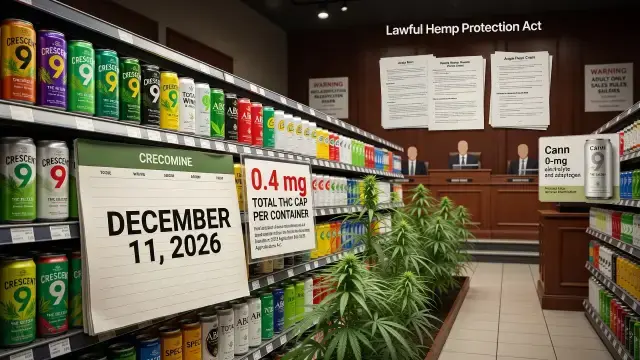
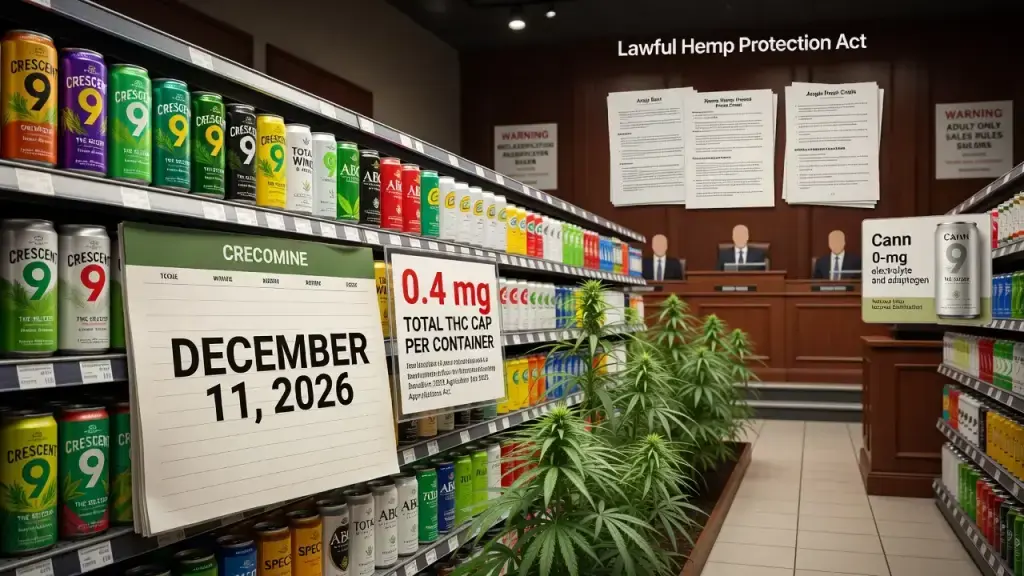
The hemp-derived THC beverage category just closed out its best sales year on record, with the U.S. market valued at roughly $1.4 billion. That success now sits beside a federal deadline that could wipe the segment out almost entirely. Barring Congressional action, a reclassification law set to take effect December 11, 2026, would cap total THC per container at 0.4 milligrams - a threshold so low that virtually every product currently on shelves, including the lowest-dose options, would be rendered noncompliant overnight.
How a Farm Bill Loophole Built a Billion-Dollar Category
The category exists because of language, not intent. The 2018 Farm Bill legalized industrial hemp containing under 0.3% delta-9 THC by dry weight, a threshold meant to distinguish fiber and grain hemp from marijuana. What it didn't anticipate was beverage formulation: companies could stay under that dry-weight limit while still delivering a meaningful total THC dose per can. That gap let hundreds of brands build legal, shelf-stable THC drinks sold in liquor stores, grocery chains, and convenience outlets - channels marijuana products, federally classified as Schedule I, could never touch. States layered their own rules on top, and roughly 25 states now permit recreational cannabis sales while about 40 allow medical use, creating a patchwork that beverage brands have had to compliance-map state by state.
The Reclassification Law and Why the Math Doesn't Work
Congress's 2025 Agriculture Appropriations Act narrowed the hemp definition and set that 0.4-mg total THC ceiling per container. To put it plainly, that's not a dosage cut - it's an extinction event for the category as currently formulated, since even entry-level low-dose drinks carry at least 1 mg of THC. The original November 12, 2026 effective date got pushed to December 11 after the Senate passed a short-term funding bill, buying the industry roughly one more month. That's not relief; it's a stay of execution. Operators like Crescent Canna, maker of the Crescent 9 THC seltzer line, describe the operational bind plainly: carrying two to three months of inventory that could become unsellable, with no clear signal on whether to keep production running or wind it down. Farmers face the same dilemma before next season's planting decisions.
Industry Response: Advocacy, Reformulation, and a Push for Alcohol-Style Rules
The bipartisan Lawful Hemp Protection Act, introduced by Senators Andy Barr and Angie Craig, is the industry's preferred off-ramp. It would create federal oversight through the Alcohol and Tobacco Tax and Trade Bureau, impose milligram-based excise taxes, mandate domestic sourcing, ban synthetic cannabinoids, and standardize lab testing and labeling nationally - effectively moving hemp beverages toward the three-tier regulatory model that governs beer, wine, and spirits. That framework matters to retailers for a simple reason: predictable compliance rules are easier to build a wholesale menu around than a shifting patchwork of state serving-size limits and labeling requirements.
Some brands aren't waiting. Cann launched a 0-mg version of its lineup this year, trading cannabinoids for electrolytes and adaptogens to gain national distribution without triggering THC-specific restrictions. Others, including members of the Hemp Beverage Alliance, are running consumer letter-writing campaigns tied to the pending legislation. On the retail side, coalitions including the Beverage Alcohol Merchants Coalition - whose members include Total Wine & More, ABC Fine Wine & Spirits, Spec's, and BevMo - are pushing for adult-only sales requirements, mandatory testing, per-serving dose caps, and distribution restricted to licensed retailers and wholesalers, arguing that regulation, not prohibition, is the only workable path.
What's at Stake for Operators and Retailers
- Retailers carrying THC beverages face potential forced destruction of compliant inventory if the reclassification law takes effect without amendment
- Multi-state brands must continue navigating inconsistent state-level serving sizes and labeling rules in the interim
- Advertising restrictions on platforms like Meta continue limiting how compliant brands can reach adult consumers
- Farmers growing hemp for beverage-grade cannabinoids face planting decisions with no regulatory certainty past next month
The underlying tension is straightforward: a product category built on a drafting gap now needs deliberate legislation to survive, and lawmakers have given themselves barely more runway to write it.