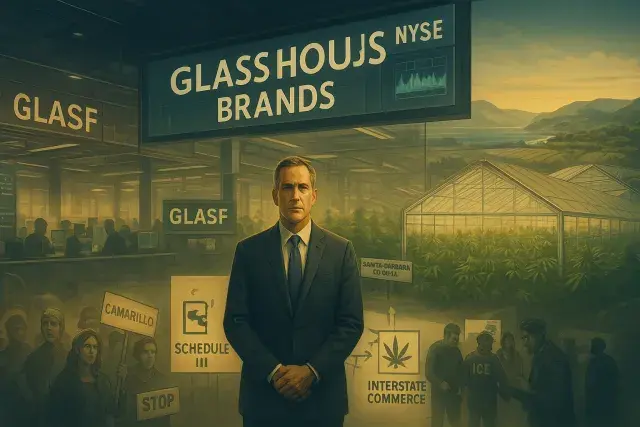
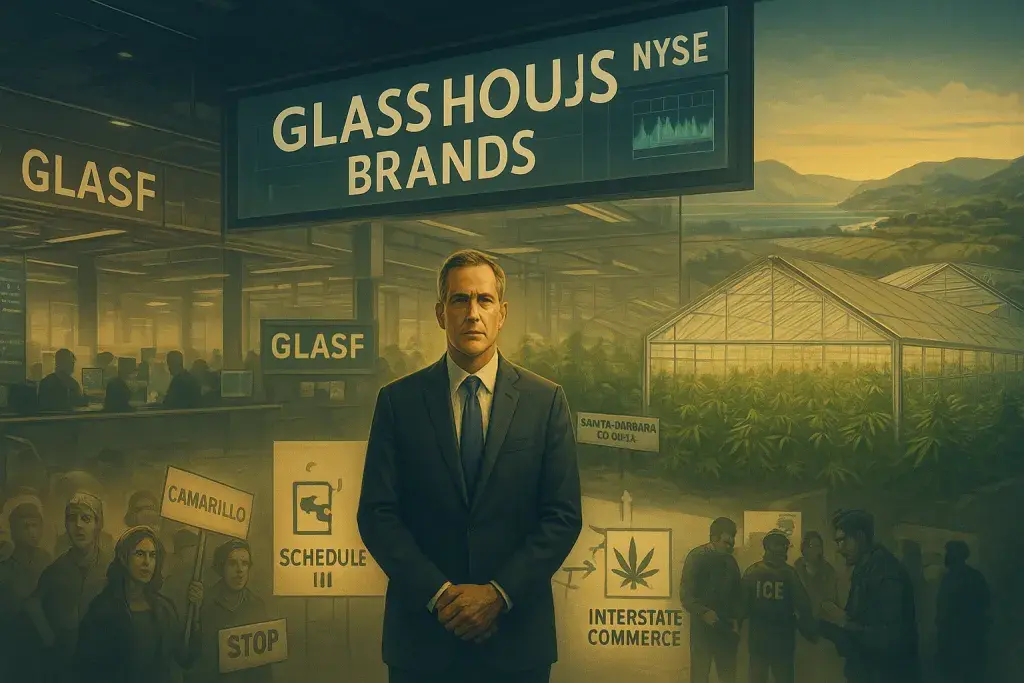
Glass House Brands became the second U.S. cannabis company to list on the New York Stock Exchange this summer, a milestone that would have seemed implausible even two years ago. For Graham Farrar, who has spent a decade building vertically integrated cannabis operations across Santa Barbara County, the listing is less a capstone than a starting position. The company is now eyeing international exports and eventual interstate commerce - and, for the first time, the federal regulatory structure may actually be helping.
The path to the NYSE ran directly through the DEA's rescheduling process. When President Trump signed an executive order last December directing that cannabis be reclassified from Schedule I to Schedule III under the Controlled Substances Act, it triggered a regulatory chain reaction with real business consequences. Schedule I status had long locked cannabis operators out of institutional capital markets, conventional banking relationships, and most interstate commerce structures. Schedule III doesn't fully resolve those barriers, but it changes the legal posture in ways that matter - particularly for a company with export ambitions. To qualify under the DEA's final rules, Glass House restructured entirely, splitting into two separate corporate entities: one licensed exclusively for medical cannabis, which is the entity now trading on the NYSE, and a separate adult-use operation. That kind of corporate bifurcation isn't simple. It requires careful attention to licensing transfers, equity structure, and ongoing compliance obligations across two regulatory frameworks simultaneously. Dispensary operators and multi-state operators watching this maneuver should note that the regulatory needle Glass House is threading is narrow - and the compliance architecture to support it has to be airtight. Resources like IndicaOnline Rhode Island illustrate how cannabis software providers are increasingly building state-specific compliance infrastructure to help operators manage exactly these kinds of layered regulatory environments.
The rescheduling took effect April 23, and Glass House applied for Schedule III designation immediately. Farrar's stated next move is exporting to Germany, followed by pursuing interstate commerce if and when federal law allows it. His analogy is blunt: a consumer in New Jersey isn't expected to drink only New Jersey wine. The argument tracks with how other regulated commodities have scaled - but cannabis isn't there yet, legally or logistically. Interstate commerce in cannabis would require either additional federal action or a structural change in how the Controlled Substances Act treats state-licensed operators. Neither is imminent. Still, a NYSE-listed, Schedule III-designated medical cannabis company is structurally better positioned for that conversation than a Schedule I operator trading on a Canadian exchange.
The ICE Raids and What They Cost the Company
The NYSE listing arrived roughly a year after one of the most disruptive enforcement actions in California cannabis history. Federal immigration agents raided Glass House operations in Carpinteria and Camarillo last July in a military-style operation. Three hundred sixty-one employees were detained or arrested. One person died after falling from a height of 30 feet while attempting to flee. Five hundred protesters gathered in Camarillo; non-lethal force including tear gas, smoke grenades, and rubber bullets was deployed. Santa Barbara's district attorney publicly called the use of force disproportionate.
Farrar later clarified that nine of those detained worked directly for Glass House; the rest were employed through third-party labor contractors. That distinction matters operationally, but it doesn't fully insulate a licensed cannabis business from the reputational and workforce consequences of what happened on its premises. Glass House has since replaced its labor contractors and installed an identity verification system. For cannabis operators who rely on contract labor - common in cultivation and processing - this episode is a sharp reminder that workforce compliance due diligence extends to every person working on a licensed facility, regardless of who cuts their check. Immigration enforcement at a cannabis worksite creates compounding risk: operational disruption, regulatory scrutiny, licensing exposure, and investor relations pressure all arrive at once.
Local Licensing and the Odor Problem That Won't Go Away
For all the momentum at the federal level, Farrar is still fighting a localized compliance battle that has nothing to do with stock exchanges. Santa Barbara County revoked his operating license at his Carpinteria facility over failure to install carbon-scrubbing odor control systems the county requires. Farrar appealed, arguing the Board of Supervisors denied him an extension he's entitled to under county ordinance. He says he installed Infinity scrubbers at one of his two locations, and that Southern California Edison cannot deliver sufficient electrical capacity to power the required systems at the other.
That's not an unusual problem in large-scale cultivation. High-efficiency carbon scrubbers draw significant electrical load, and grid capacity constraints in rural or semi-industrial zones can make compliance timelines genuinely difficult to meet - not just inconvenient. The county's position is that the timeline has already run. Farrar's position is that the infrastructure dependency on a regulated utility constitutes a legitimate extension trigger. The appeal is unresolved. What's worth noting here, without editorializing too heavily, is the gap between a company sophisticated enough to dual-list on two stock exchanges and restructure its corporate entities for federal rescheduling - and a company still fighting a county odor ordinance that dates back years. Cannabis licensing at the local level remains unforgiving, and good standing with municipal or county regulators doesn't follow automatically from success at the capital markets level. They operate on entirely different clocks.
What This Means for the Industry
Glass House's NYSE listing is consequential beyond one company's trajectory. Florida-based Trulieve listed on the NYSE first, in June of this year. Two U.S. cannabis operators on the New York Stock Exchange is a data point, not a trend - but it signals that institutional investors are beginning to treat Schedule III-eligible cannabis companies as legitimate equity instruments rather than speculative OTC plays. That shift, if it holds, has downstream implications for the entire licensed cannabis supply chain: wholesale pricing power, access to institutional debt, retail expansion capital, and the credibility that comes with a major exchange listing all become more accessible to operators who can structure themselves correctly.
The catch is that "structuring yourself correctly" currently requires splitting your company in two, navigating DEA designation rules, managing dual licensing frameworks, and surviving whatever the local zoning board throws at you in the meantime. Most cannabis operators don't have the balance sheet or legal resources to execute that. Glass House does - and even they are doing it while appealing a county license revocation and rebuilding a workforce disrupted by federal immigration enforcement. The industry has rarely offered a cleaner illustration of how many pressure points a cannabis operator can face simultaneously, at every level of government, all at once.