A one-month reprieve is not a fix. The federal ban on intoxicating hemp products, now set to take effect Dec. 11 instead of Nov. 12, has given operators across a multibillion-dollar supply chain a brief window to lobby Congress rather than wind down their businesses. For companies making THC gummies, seltzers and vape products under the 2018 Farm Bill's hemp definition, the stakes are existential.
How a Fiber Crop Became an Intoxicant Loophole
The 2018 Farm Bill legalized hemp by setting a threshold - less than 0.3% delta-9 THC by dry weight - meant to distinguish industrial hemp from marijuana. That threshold works fine for rope and building materials. It works far less well for food and beverage products, where "by weight" calculations allow a large gummy or a can of seltzer to carry enough delta-9 THC to produce real impairment while staying technically compliant. That gap let an entire category of unregulated, often untested products move through gas stations, convenience stores and e-commerce - with none of the age verification, lab testing, or compliant packaging requirements that licensed, state-regulated dispensaries must follow.
For operators holding adult-use or medical licenses, this has been a persistent competitive sore point. Licensed cannabis retailers absorb excise tax, seed-to-sale tracking costs, 280E tax burdens, and strict COA requirements on every batch. Hemp-derived THC sellers, until now, largely did not. That asymmetry is part of why legal cannabis operators and their lobbyists support the ban rather than opposing it.
What a 0.4-Milligram Cap Would Actually Do
The version of the ban now on the books sets the allowable THC limit at 0.4 milligrams per container - a number industry groups describe as low enough to eliminate not just intoxicating products but some non-impairing CBD items, including topical lotions. That's the detail driving the current lobbying push. Hemp beverage and edible makers say they could live with a higher per-package cap, paired with 21-and-over sale restrictions and limits on imported cannabis compounds. What they can't survive, by their own account, is a threshold so low it zeroes out the product category entirely.
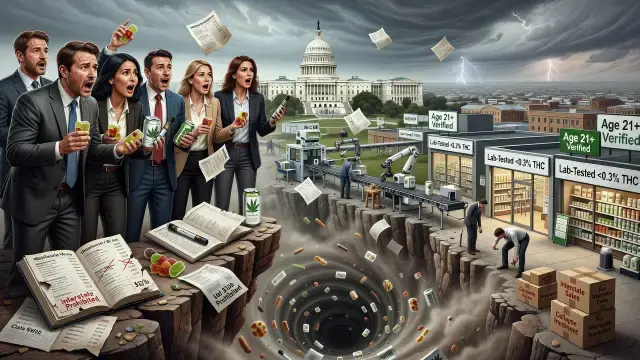
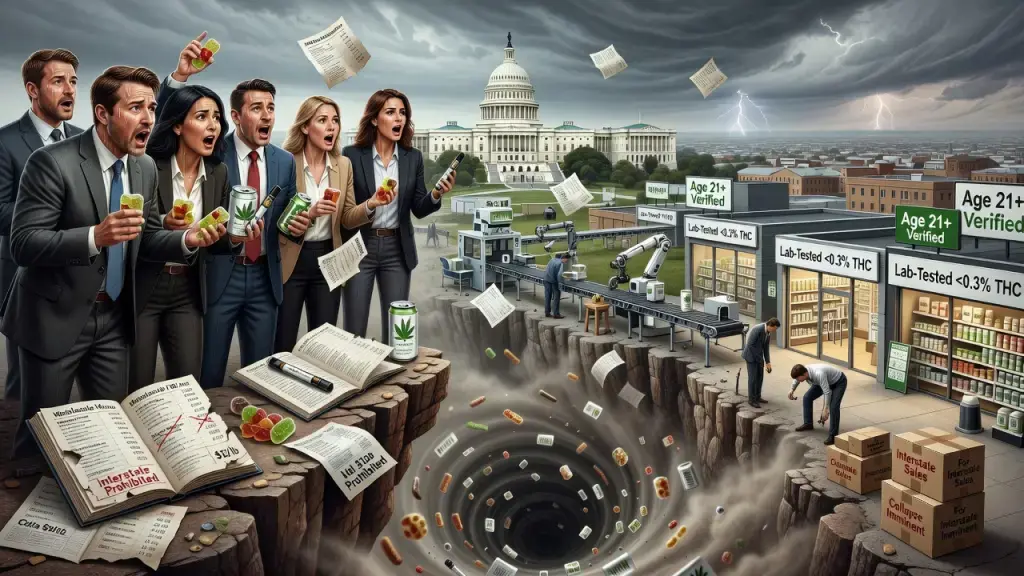
For wholesale buyers, brand owners and retailers carrying these SKUs, the practical questions are immediate: What happens to existing inventory after Dec. 11? Do interstate wholesale menus collapse overnight? Does a company pivot to an in-state-only model under a new state hemp program, assuming one exists?
Market and Operational Fallout
Industry-funded research cited by hemp advocates projects steep revenue losses, job displacement, and reduced state sales tax collection if the ban proceeds as written - figures that should be read as advocacy estimates, not neutral forecasts, given who commissioned them. Still, the operational disruption is not speculative. Some beverage producers have already paused production and cut staff ahead of the deadline, a reminder that compliance deadlines in cannabis-adjacent industries carry real payroll consequences, not just paperwork.
- Interstate hemp THC sales would likely end if the ban takes effect as written
- Products could still survive in states that build their own regulated hemp programs
- Retailers and distributors face inventory and wholesale contract exposure around the Dec. 11 date
- Licensed, state-regulated cannabis operators largely support the ban as a competitive correction
The Regulatory Path Forward
The more likely long-term outcome, according to cannabis policy lobbyists, isn't elimination but a slow migration toward state-by-state regulation - age restrictions, potency caps, lab testing and compliant packaging rules modeled on alcohol and licensed cannabis retail. That would mean fewer products on convenience store shelves and more operating inside frameworks resembling dispensary compliance. For operators built entirely around the interstate hemp loophole, that transition - if it happens at all - will not arrive in time to save every business currently on the books.