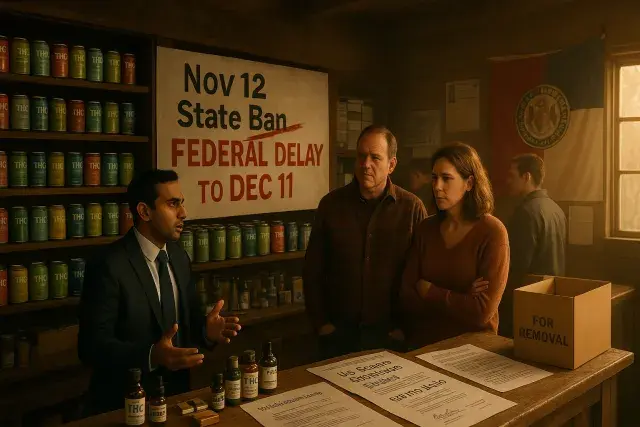
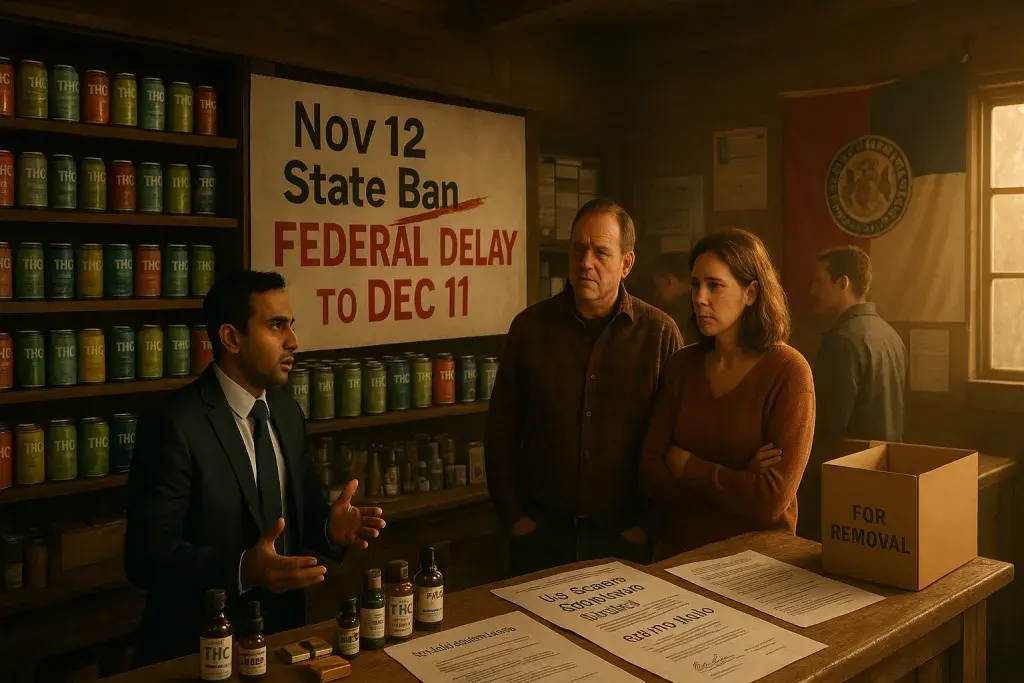
Missouri retailers selling hemp-derived THC beverages got a reprieve, at least on paper, when the U.S. Senate approved a stopgap funding measure early Saturday that would push back the federal ban on intoxicating hemp products until Dec. 11. The bill still needs House approval and the president's signature, but if it clears both, hemp beverages could stay on Missouri store shelves past the state's own Nov. 12 deadline. Everything else in the intoxicating hemp category - edibles, tinctures, vapes - remains slated for removal under state law regardless of what happens in Washington.
That's the odd mechanical quirk buried in the Missouri bill Gov. Mike Kehoe signed this spring. Lawmakers wrote in a carve-out: if Congress delays the federal ban, beverages get to keep operating under the existing framework while the rest of the hemp product category still goes dark on schedule. For operators trying to plan inventory, staffing, and wholesale commitments around a moving compliance deadline, this is the kind of regulatory patchwork that makes point-of-sale configuration and SKU management genuinely difficult. Retailers in states with clearer rules - the sort of environment supported by a dedicated cannabis POS for Tennessee dispensaries - have an easier time forecasting what stays compliant and what doesn't. Missouri operators right now don't have that luxury. cannabis POS for Tennessee dispensaries
Jay Patel, president of the Missouri Hemp Trade Association, called the Senate vote a "good sign," noting the 61-31 margin reflected bipartisan appetite for more time to sort out federal hemp policy. But he was blunt about the limits of what a federal delay actually accomplishes: "Whatever happens on the federal side, it's not going to fully solve our problems in Missouri." That's a fair read. A funding bill extension buys time; it doesn't rewrite the state statute that still bans everything except beverages come November, nor does it resolve the underlying legal fight over how Missouri defines hemp versus marijuana in the first place.
A Narrow Exception With Broad Consequences
The beverage-only carve-out creates a strange bifurcation for hemp businesses that sell across multiple product categories. John Grady, who owns Slaphappy Hemporium with his wife Kara in Rosebud, Missouri, put it plainly: the company started as a beverage producer, so the delay helps that side of the business. But it does nothing for the edibles and other products that will still come off shelves in November no matter what Congress does. Operators in this position are already watching customers stock up on soon-to-be-banned items, a pattern familiar to any regulated retailer facing a hard compliance cutoff - think of it as a slow-motion version of last-call inventory clearance, except with legal exposure attached if timelines shift again.
Litigation Still Looms Over the Whole Framework
The Missouri Hemp Trade Association and a coalition of hemp businesses aren't waiting on Congress. They filed a federal lawsuit last month in the U.S. District Court for the Western District, arguing the state law's definitions of hemp and marijuana are unconstitutionally vague. That case runs on its own timeline, independent of whatever happens with the federal funding bill, and it introduces a second layer of uncertainty for compliance teams. Even if beverages survive past Nov. 12 thanks to the federal delay, the underlying state law could still be challenged, amended, or upheld in ways that reshape the rules again before December.
What Operators Should Be Tracking
For dispensary owners, wholesalers, and brands operating in or supplying the Missouri hemp market, a few things matter more than the headline vote count:
- Whether the House passes the same delay language the Senate approved, since amendments could strip the hemp provision entirely
- How compliant packaging and labeling requirements might shift again if the state law is amended following the lawsuit
- Wholesale menu adjustments needed if edibles and other non-beverage SKUs must be pulled by Nov. 12 regardless of federal action
- Coordination with legal counsel on inventory disposal or transfer plans for products that lose compliant status
Grady and other operators are part of coalitions pushing to use whatever runway the Dec. 11 deadline provides to get comprehensive federal hemp regulation in place - something more durable than another short-term patch. Whether that happens is an open question. What's clear is that Missouri retailers are operating under a compliance calendar with at least two different expiration dates, one federal and one state, and a lawsuit that could reset both.