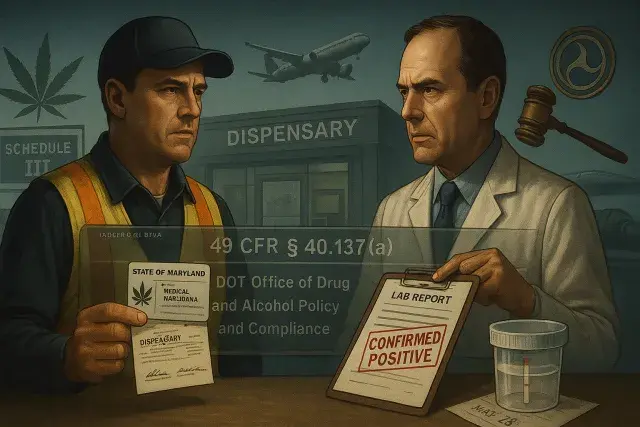
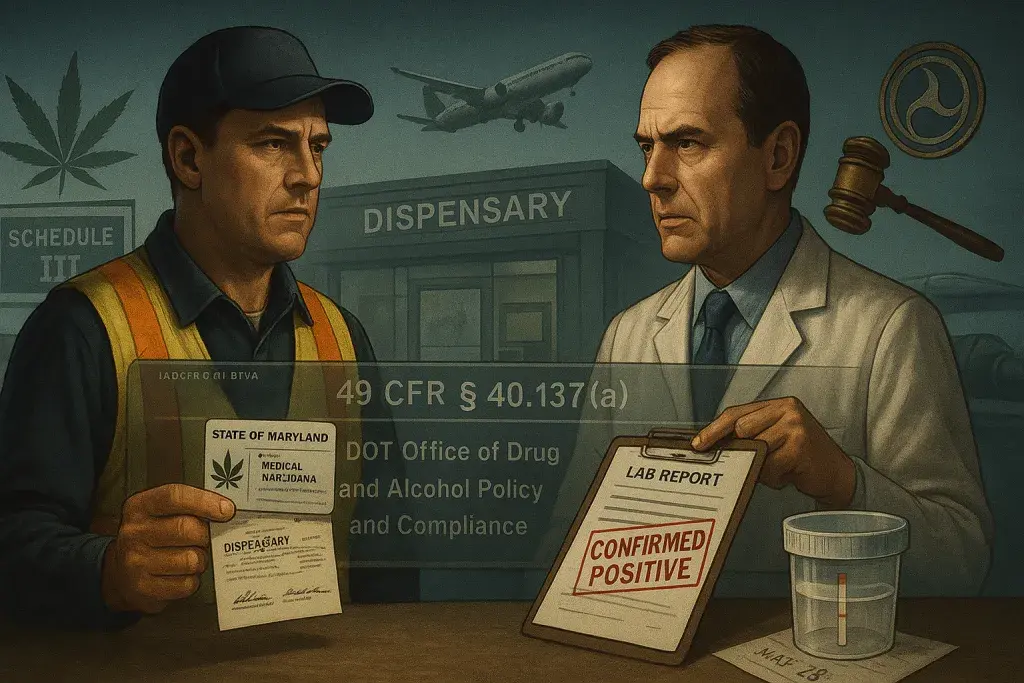
The Department of Transportation's Office of Drug and Alcohol Policy and Compliance issued formal guidance on May 15, 2026, making one thing unmistakably clear: the DOJ's reclassification of certain marijuana products to Schedule III of the Controlled Substances Act changes nothing for DOT-regulated employees. Medical marijuana cards, dispensary receipts, and physician recommendations still cannot reverse a confirmed positive drug test result under federal transportation rules. For safety-sensitive workers - and the employers who manage them - the compliance calculus has not moved an inch.
The DOJ order, dated April 22, 2026, immediately placed FDA-approved marijuana products and state-licensed medical marijuana products in Schedule III, a shift that generated real confusion across multiple regulated industries. Employers in transportation-adjacent sectors, HR departments, and even some compliance officers began asking whether the rescheduling created an opening for employees to cite state medical marijuana programs as a defense. It didn't. The ODAPC guidance draws a firm boundary: state-dispensed marijuana is not FDA-approved, and without FDA approval, a controlled substance cannot be legally prescribed under federal law. That distinction carries significant operational weight for any business running a DOT-regulated workforce - and it has quieter implications for licensed cannabis operators, too, particularly those in markets like Maryland, where compliance infrastructure around cannabis sales continues to mature; operators there relying on a dispensary pos system maryland are tracking retail-side compliance, but the employment-side rules answer to an entirely different federal authority.
What the MRO Cannot Do - And Why That Matters
Under 49 CFR §§ 40.137(a) and 40.141(b), a Medical Review Officer verifying a laboratory-confirmed positive drug test can only report it as "negative" if the employee demonstrates a "legitimate medical explanation" - defined as use of a legally prescribed controlled substance, compliant with federal prescription law. Here's the catch: marijuana, even now at Schedule III, is not available by federal prescription from a state dispensary. A Schedule III classification permits prescription through FDA-approved pathways. State dispensaries operate outside those pathways entirely.
So the stack of documentation an employee might present - a state-issued medical marijuana card, a physician certification, dispensary purchase records - fails at every level. None of it satisfies part 40 requirements. The MRO's hands are tied by the plain text of the regulation, not by any policy preference about marijuana. That's a meaningful distinction. The guidance isn't an editorial stance on cannabis; it's a reading of what the federal prescription framework actually requires.
The Compliance Risk for DOT-Regulated Employers
For covered employers - motor carriers, transit agencies, airlines, railroads, and pipeline operators among them - the ODAPC guidance removes any ambiguity about what testing protocols should look like going forward. DOT drug and alcohol testing regulations remain operative. Marijuana stays on the testing panel. A positive is still disqualifying for safety-sensitive functions, full stop.
What employers should watch for is the pressure that will come from employees, and sometimes from HR staff unfamiliar with federal preemption, who believe the Schedule III reclassification opened a door. It did not. The operational risk here is procedural drift - a manager who accepts a medical marijuana card as a mitigating document, or an MRO who applies state-law logic to a federal-law process. Either error creates liability exposure that no state program can resolve.
- State medical marijuana cards do not constitute a legitimate medical explanation under 49 CFR § 40.137(a).
- Physician recommendations or certifications issued under state programs do not satisfy federal prescription requirements.
- Dispensary records and purchase receipts carry no weight in the MRO review process.
- Marijuana use remains incompatible with safety-sensitive functions under DOT rules, regardless of rescheduling status.
Broader Signals for the Licensed Cannabis Industry
The ODAPC guidance is, on its surface, a transportation compliance document. But it sends a signal the cannabis industry should read carefully. Rescheduling - even a genuine, immediate one - does not automatically cascade into protections for end consumers or patients in federally regulated employment contexts. The FDA-approval pathway remains the governing standard for what counts as a legitimately prescribed controlled substance. State dispensary frameworks, however well-regulated at the state level, exist outside that federal approval architecture.
That gap matters for how cannabis operators communicate with their customers. A patient purchasing from a licensed dispensary under a state medical program may be in full compliance with state law and still face serious federal employment consequences. Responsible dispensary operators, particularly those serving patients in safety-sensitive occupations, should not be presenting state medical marijuana documentation as a universal shield. The ODAPC guidance makes clear it isn't one. That's not a reason to discourage legal, regulated purchases - it's a reason to make sure the compliance picture patients receive is accurate.
The rescheduling story is far from over. But in the federal transportation sector, for now, the answer is the same as it was before April 22, 2026: a positive is a positive.